The first evening the fireflies rose, thick and slow and gold above the grass at Firefly Grove, Pip Lark came around the last bend of the near road and found something he had never once seen in all his visits to Adventurer's Rest: Marrow Wren, sitting entirely still, doing nothing at all.
She was not mending, not kneading, not carrying, not writing. She sat on the low stone wall at the wood's edge with her hands loose in her lap, watching the small gold lights lift out of the grass one, and then a dozen, and then, all at once, a hundred, and she did not look up when he stopped walking.
“You're doing nothing,” Pip said, before he could stop himself. It came out more astonished than he meant it to.
“I am watching the fireflies,” Marrow said. “It counts as something. Once a year.”
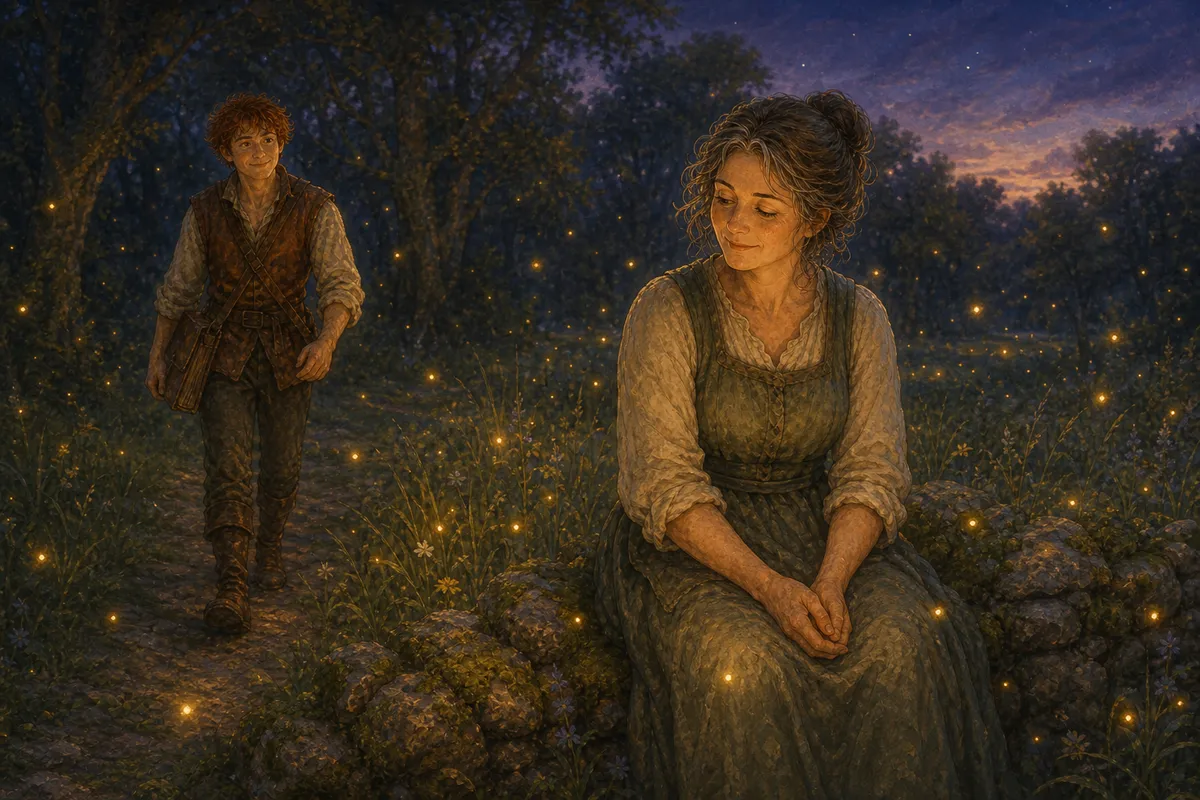
He sat beside her without being asked — he had learned that much, at least, in the year and more since his boots had first dripped rain onto her floor — and for a while they only watched the grove fill up with light.
“I finished the eastern half,” Pip said eventually. “The whole coast, up past the old lighthouse. I marked every good thing I could find. There's a bakery in a fishing town no one's ever written down that does something extraordinary with a plain loaf, and I put it on the map. My master would call that no kind of surveying at all.”
“Your master hasn't tasted the bread.”
Pip laughed — the same laugh, Marrow thought, that had filled her common room that first wet night, only steadier now, like a fire that had stopped needing tending. He reached into his coat, out of habit more than plan, and touched the corner of the map case he still carried everywhere, though it was thicker now, fuller, the blank cream long since crowded with small green trees and bending roads and here the moss is soft enough to sleep on.
“I marked it,” he said. “This place. Just like you told me to, that first night. Right where the three roads meet.” He was quiet a moment, watching a firefly climb past his knee. “I think about that a lot, actually. What you said. That I'd want to mark a good place to stop.”
“It seemed the useful thing to tell a boy who was about to walk in circles for a year, mapping a world that wasn't going anywhere.”
“Maybe.” He turned toward her, and something in his face had gone more careful than she remembered it being able to go. “I've been to a lot of places since then, Marrow. Sunrise Harbor, twice. Half the forest road. A whole coastline. And everywhere I go, people ask me things — where's a good bed, where's a kind face, where's the crossroads inn everyone talks about — and I tell them all about you, without ever once knowing anything about you.” He shifted, awkward now, as though the words had gotten ahead of the courage meant to carry them. “You gave me a place to stop. Did you ever mark your own?”
The fireflies kept rising. Marrow watched them a long while before she answered, and when she did, her voice had dropped into something Pip had never heard from her before — not the innkeeper's voice, warm and certain, that drew stories out of other people, but a quieter one. The voice, perhaps, of someone remembering how to use a language she had not spoken in a very long time.
“I did,” she said. “Though it took me rather longer to draw the map than it took you.”
“Before any of this,” she began, “before I ever set foot on a road that wasn't already paved for me, I kept a book much like the one behind my bar. Only it wasn't stories I wrote in it then. It was leavings.”
“Sunset Kingdom,” she said, when he only stared. “Not because anyone named it cruelly. Because that was simply what it was doing, the whole while I lived in it. Setting.”
“I was an apprentice under the palace's last archivist — an old woman with ink permanently in the creases of her hands, not unlike yours, and no patience for anyone who wrote an untidy line. It was her whole art, and then mine: when a courtier left — and by the time I came to her, they were always leaving, a few more with each season, the halls a little emptier each winter — she would sit with them the night before and ask what they had seen, living there, and what they meant to remember. Not who owed what. Who had loved whom. Who had once laughed so hard in the east gallery that a vase came down. The kingdom was ending, Pip, but so gently no one could point to the day it happened. It only thinned, the way a fire thins toward morning. Log by log. No single moment you could call the end of it.”
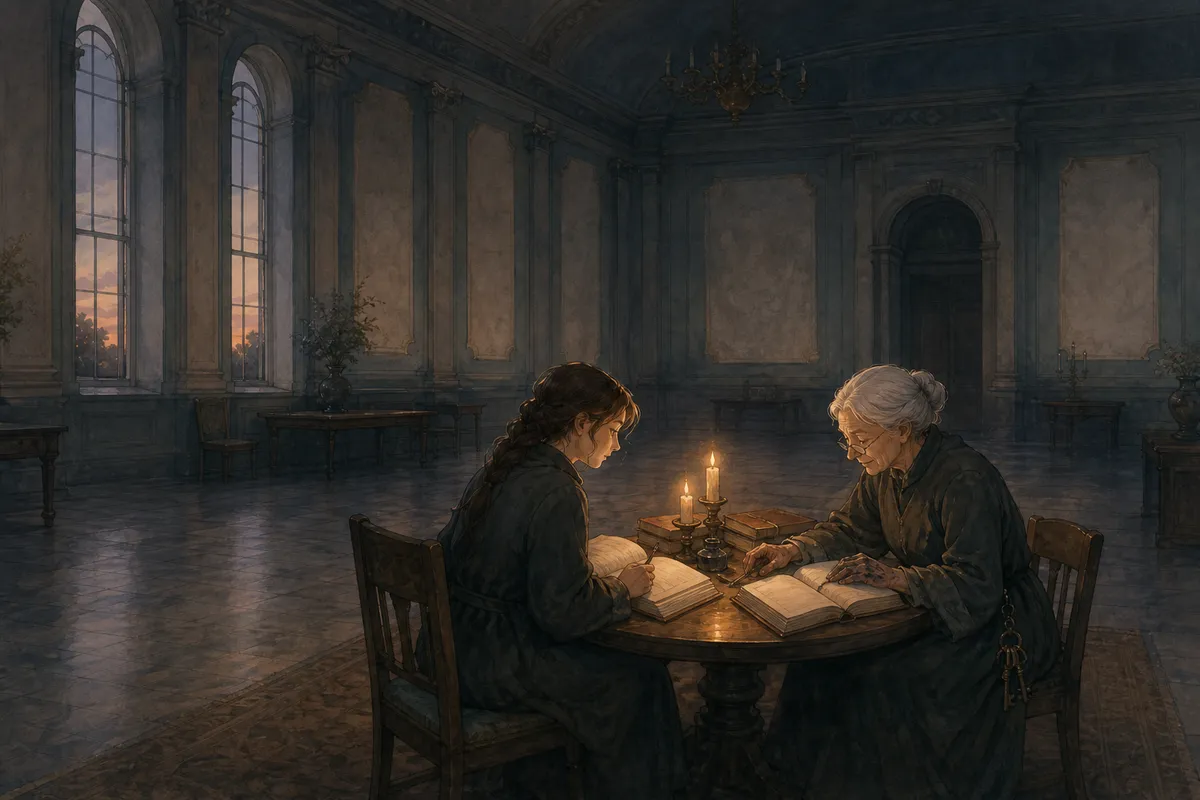
“And that was your work,” Pip said slowly. “Sitting with people as they left.”
“For nine years. I got very good at it. Better, I think, than she ever was, though she'd never have said so — she wasn't the saying-so sort. I could sit with a duchess who'd lost an entire province and a scullery girl who'd lost nothing but a place to sleep, and draw the same true thing out of both of them, because in the end it's the same question, isn't it. Where have you come from. What did you see on the way.” The ghost of a smile. “It isn't so different from what I ask now, if you think about it.”
There came a winter — the last one, though neither of them called it that yet — when the halls were down to a handful of us, and even the queen had gone quietly north to a cousin who still kept a fire lit. My teacher sat me down one evening with her own first book, the one she'd kept since before I was born, and set it in my hands.
“She said the kingdom's story was finished being lived, and had only the writing-down left to do, and that she had done enough writing-down for one lifetime. Then she gave me a second book. Blank. Every page of it — the kind you buy new and are almost afraid to open, because of what the first mark will cost you.” Marrow's hands had gone still in her lap, the way, Pip thought, hands go still around something they are holding very carefully even when there is nothing in them anymore. “She said: somewhere, child, a story is still being lived. Go and find it. Write it down.”
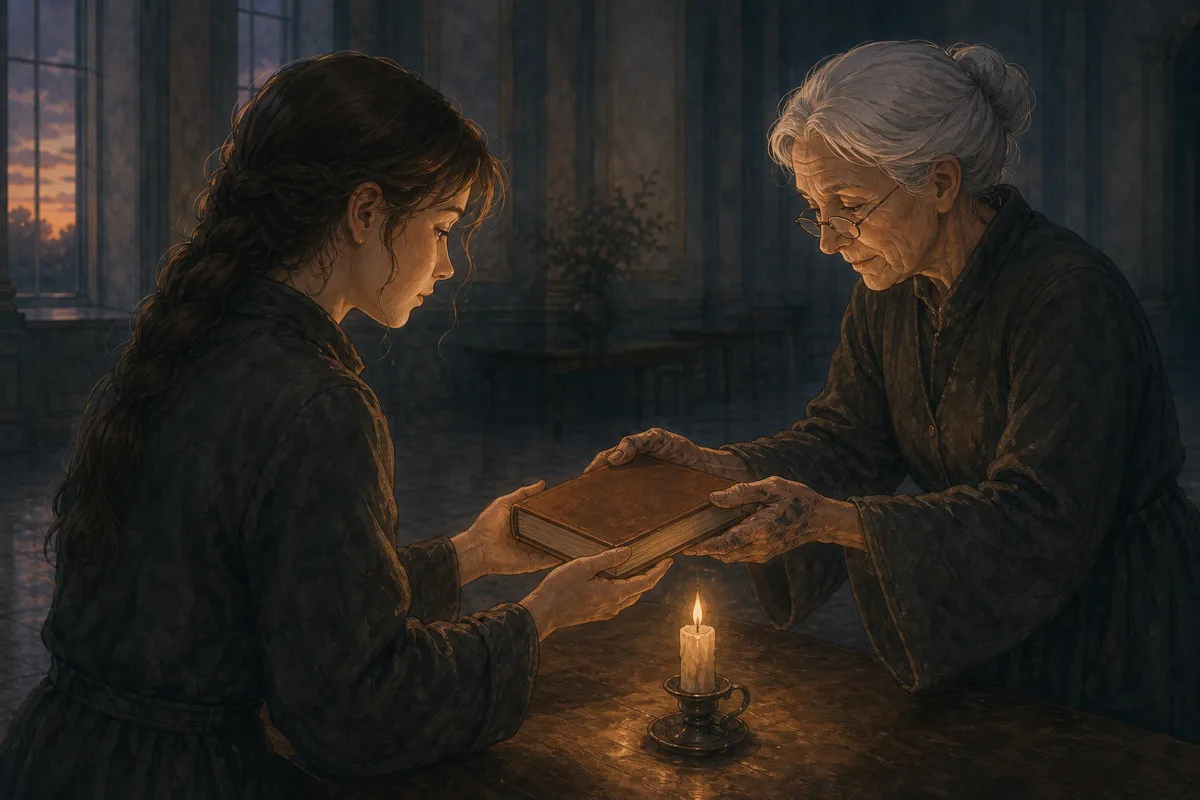
“Then she went to bed, the way she always did. And in the morning, she simply hadn't woken.”
Pip opened his mouth, and closed it, and settled instead for reaching over and, briefly, awkwardly, resting a hand on her arm — the way, Marrow thought, a person does when they have not yet learned the shape of comforting someone and are trying their best anyway. She let him. It was, she realized, the first time in a long while she had let anyone try.
“So I walked,” she went on. “Out of a kingdom with no one left in it to ask me to stay, carrying a blank book I did not yet know what to do with. I walked through a spring I don't remember and a winter I remember too well, and I stopped in a hundred places — a good well, a kind family, a room with a fire — and every time I asked myself the only question I knew how to ask. Is this it. Is this the story I was sent to find.” She shook her head, slowly. “And every time, the book stayed blank. Because I hadn't yet understood that I wasn't looking for a story to write down. I was looking for a place to stop asking whether I was allowed to stay.”
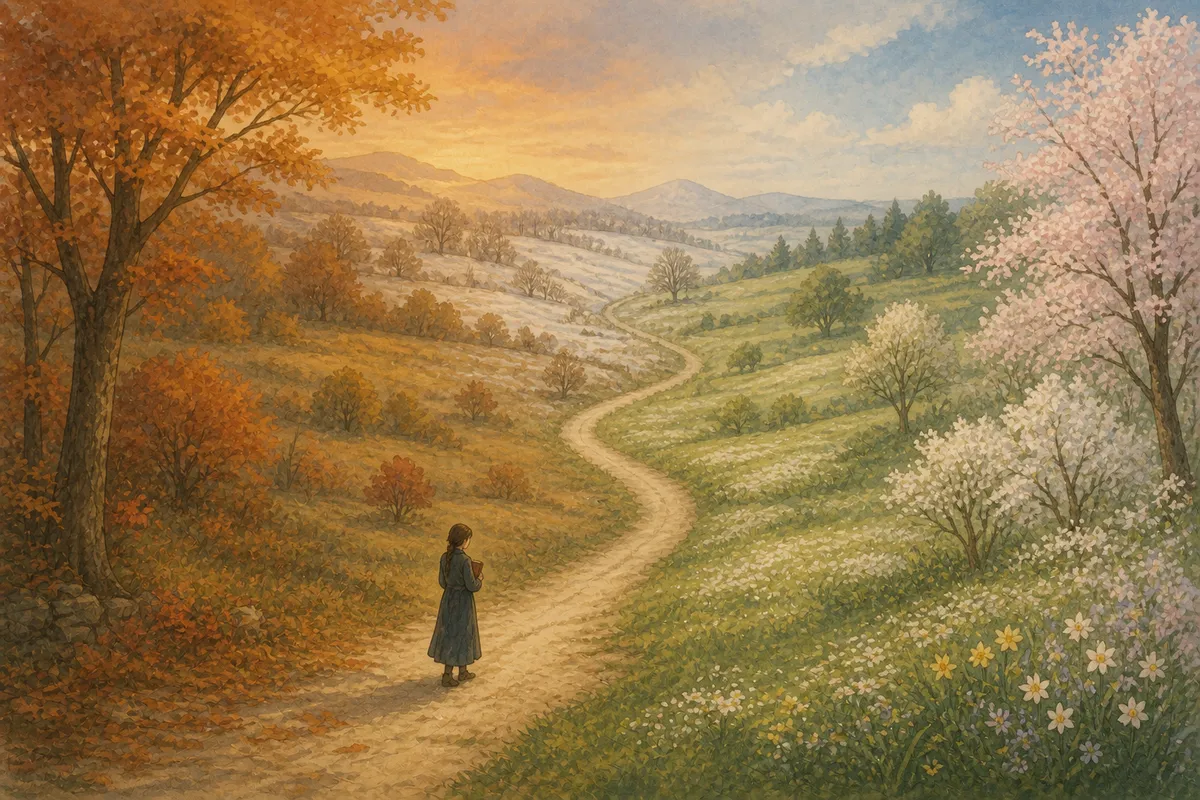
“Three years, near enough, of that. And then, one ordinary afternoon, with the light going long and gold the way it is right now, I came around a bend and found three old roads losing themselves in a valley, and at the knot where they met — an inn. Nearly empty. Door unlatched. Whoever had kept it before me had gone the way people go, and left it standing, waiting the way a place waits when it has been loved once and hasn't yet learned how to stop being ready for it.”
“I didn't ask myself if it was the story,” Marrow said. “I only knew, for the first time in three years, that I didn't want to keep walking past something. So I didn't.”
Every road, if you follow it far enough back, is a story waiting to be told. Even, as it turned out, hers.
“I opened the book that first night, alone, with no guest yet to ask anything of. And for the only time in all the years I've kept it, I wrote about myself. One line. That a woman who had spent nine years asking the leaving what they'd seen had decided, on one particular evening, to stay, and ask the arriving instead.” She looked at him, almost shy, an expression so unlike her that Pip would remember it for a long time after. “Then I closed the book, and I have never opened it to that page again, and I have never, until tonight, told a living soul what it says.”
For a while neither of them said anything. The fireflies had thickened until the whole grove seemed to breathe light, rising and dimming, rising and dimming, and somewhere behind them, faintly, the inn's own windows had gone gold with a fire someone — Coll, probably, unable to help himself — had built up without being asked.
“Can I see it?” Pip asked. Then, quickly, before she could answer: “Not the page. I don't need the page. I only meant — could I write something. In the rest of the book. The way everyone else does.”
Marrow considered him for a long moment — the boy who had first arrived here soaked to the knees and apologizing to a door, who was not, any longer, entirely a boy, who had walked farther in a year than she had in three and come back, every time, to the same crossroads on purpose. Something old in her, something used to being the only hand that ever touched that ledger, let go, quietly, the way a fist unclenches once it finally trusts the thing it's holding not to fall.
“Yes,” she said. “I think you may.”
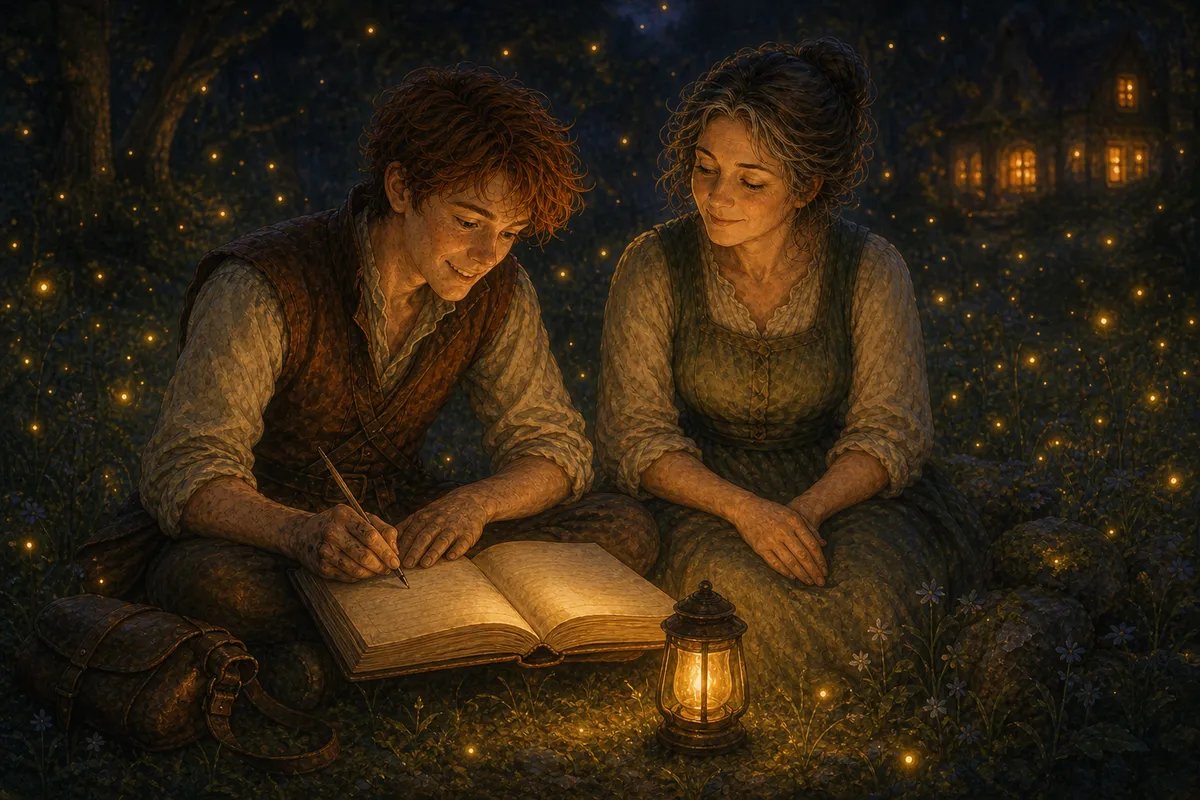
They walked back up through the grove together as the light went out of the sky, and by the fire, while Coll pretended not to watch and Marrow pretended not to mind him watching, she opened the ledger to a fresh page and set it, for the first time in all its years, in someone else's hands.
Pip thought a long while, chewing the end of the pen the way he chewed the end of every difficult sentence, and at last wrote, in a hand nowhere near as small or even as hers: here, someone finally stopped walking, and it turned out to be exactly the right place. He looked up, suddenly shy again, the way he had been shy over his own map that very first night. “Is that allowed? It isn't really a story.”
“It's the only kind that's ever been true,” Marrow said, and closed the book.
Safe. And warm. And told.