Marrow Wren was awake before the birds, as she nearly always was, and it was in that grey hour — no color yet in the sky, only the promise of it — that she saw the shape moving low among the trees of the inn's own orchard.
She knew the shape. Everyone at Adventurer's Rest knew the shape, though almost no one had ever spoken to it for longer than a greeting. Sister Quill came down from the cloister on no schedule Marrow had ever worked out — some weeks twice, some months not at all — and always at this hour, before the guests were awake to see a sister of the Dawn Cloister kneeling in the wet grass with her sleeves rolled to the elbow. She gathered what she needed from among the rows, moving with the unhurried certainty of someone who has done a thing ten thousand times and finds no need to hurry the ten-thousand-and-first.
This morning, though, something was different, and it took Marrow a moment at the orchard gate to place it.
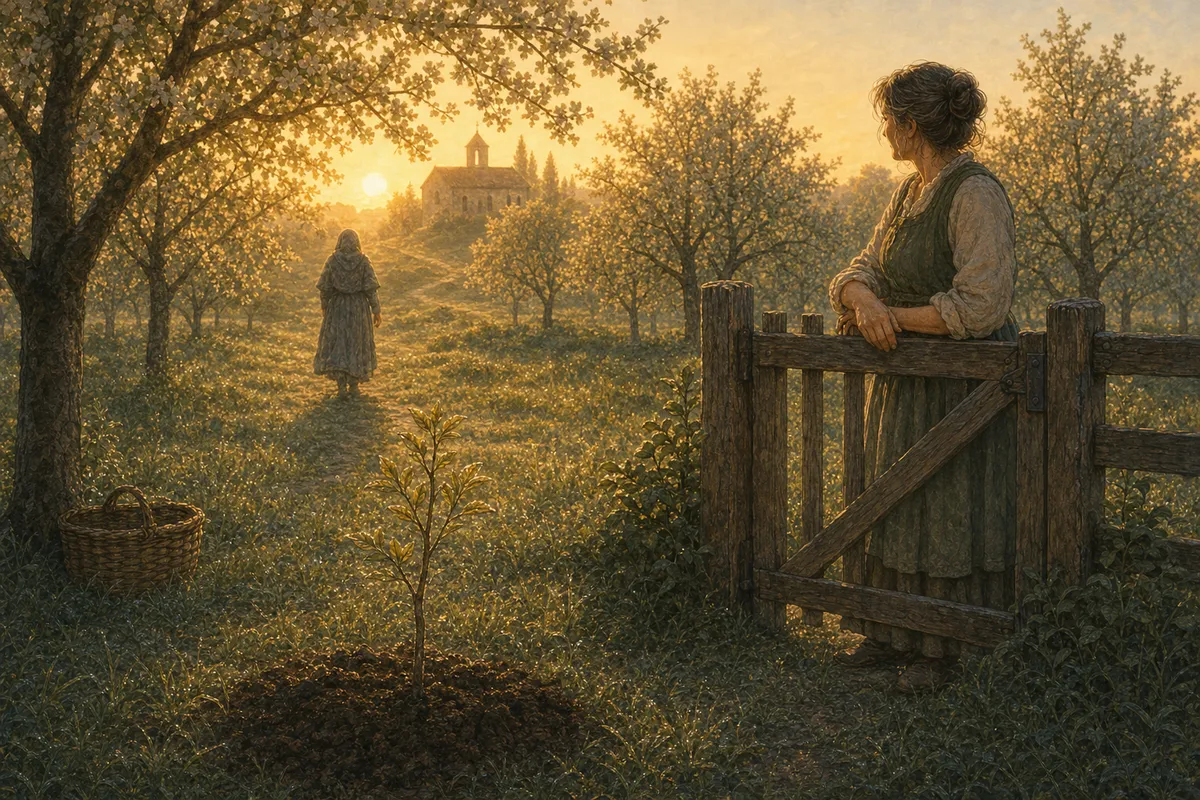
Quill's basket was still slung over one shoulder — but her hands were not full of cuttings. They were cupped, careful, around a small clay pot, and in the clay pot, dark-rooted, was a sapling no taller than a forearm.
She was not gathering. She was carrying something in.
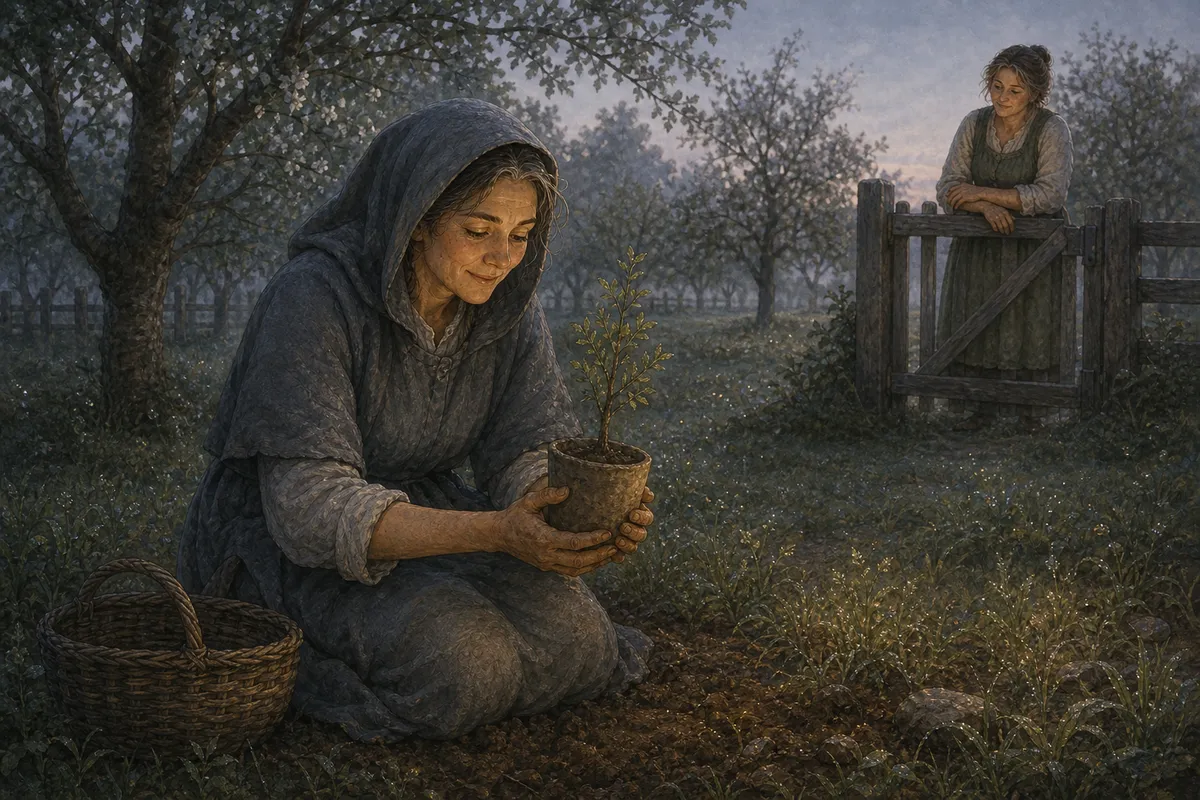
Marrow let herself in through the gate without a word, the way she had learned, long ago, not to announce herself to Coll while he worked a fence, not to interrupt Pip mid-sentence, not to ask Bly what was in his satchel until he offered it. Some people close if you reach for them. Sister Quill was one of those, though gently — she would answer any question put to her, plainly and without offense, and somehow that made the not-answering worse, because you always knew you could have asked and simply hadn't been brave enough to hear the plain true answer.
So Marrow said nothing about the pot. She only took up the second trowel from the shed, the one that lived there for exactly this purpose though it was rarely used, and knelt in the row beside her.
It had been — how long now? Four years, near enough, since the herbalist from the cloister had first appeared in the Rest's orchard at this same grey hour, and in all that time Marrow had learned almost nothing about her beyond what the rows themselves gave up: that she knew every plant in them by a name older than the one the inn used; that she worked without waste, taking only what a season could spare; that she had never once, in four years, told a story to earn her bed, because she had never once asked for one. She came, she gathered, she left before the first guest stirred, and the orchard was always the better for her passing through it.
Marrow had long since stopped needing to understand why. She had simply come to leave the second trowel out.
Today, though, Quill spoke first.
“I want this in the ground before the sun's up,” she said, turning the little pot in her hands. “It travels better in the cool.”
“What is it?”
“Yarrow. White yarrow — not the kind that already grows here.” She set it down at last, gently, in a bare patch between two older trees, and began working her trowel into the soil with the same unhurried care she gave everything. “My teacher liked it more than any plant that ever lived. Said it was honest work — closes a wound as well as anything grander, asks nothing rare to grow.”
It was, Marrow realized, the first time in four years that Sister Quill had used the word teacher.
“He taught you the cloister's ways?”
“No.” Quill did not look up from the soil. “He taught me the road's ways, first. I wasn't always at the cloister, Marrow. I was a healer before I was a sister — younger than you'd think, walking behind an old man with a satchel of the same herbs I carry now, into places that needed us badly.”
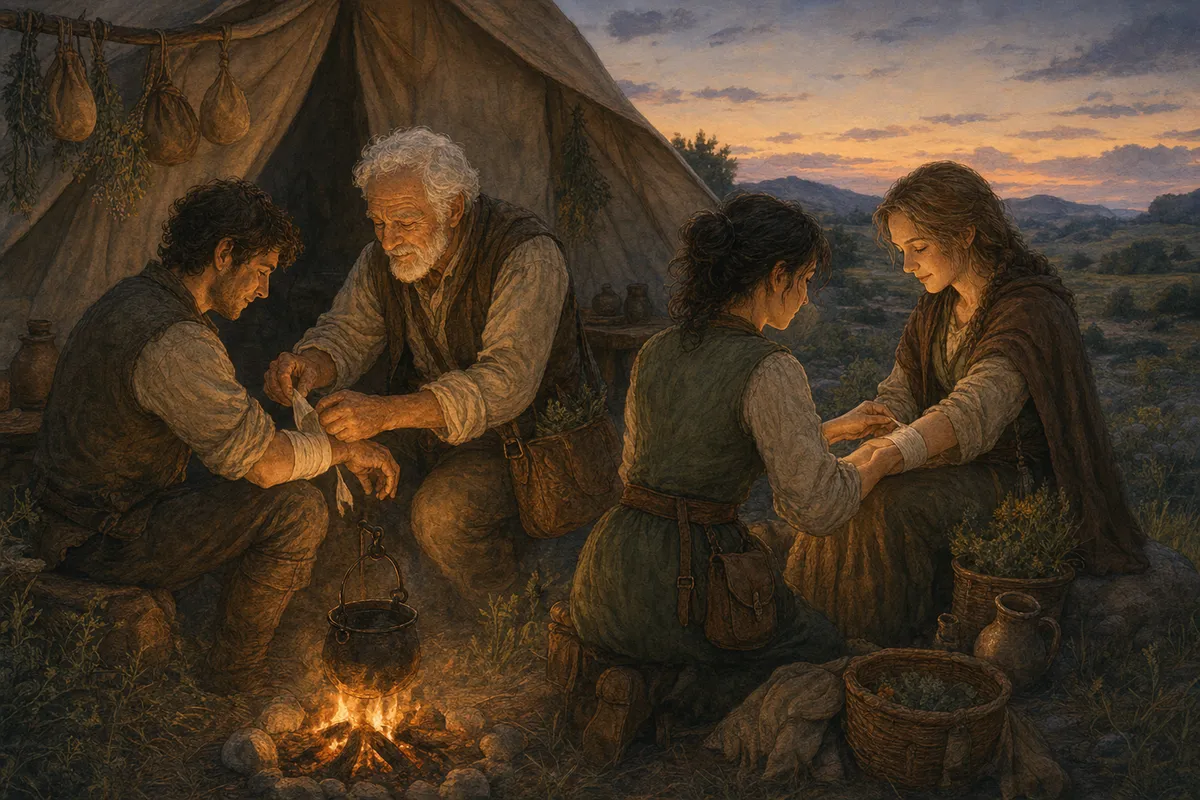
She said it the way Coll, once, had said his old company's name for him — plainly, a fact laid down rather than a wound reopened. “It was the last of the loud years. Whole roads of the wounded, some seasons — not from battle itself, most of them, by then, but from what battle leaves behind once it finally stops. Hunger. Cold. Wounds gone bad because no one was left in a village to tend them. We went where the fighting had been, after, and did what we could with what grew nearby.”
“That sounds like hard work for a young woman.”
“It was work I was good at.” A small, private smile. “He used to say I had steadier hands than he did by the time I was twenty, and gentler ones by twenty-five. I didn't believe him about the first. I believed him entirely about the second.”
She pressed the last of the soil down around the yarrow's roots with both palms — the same gesture, Marrow thought, that a person might use to settle a blanket over someone already sleeping.
“We were a strange pair on the road,” Quill went on. “An old man who'd spent forty years learning what the wild things were for, and a girl who'd spent five learning to trust him about it. But I trusted him about everything, in the end. Which is its own kind of danger, loving someone that completely. You don't notice they've begun to slow until they've nearly stopped.”
“He got old faster than he let on,” she said. “Healers are the worst patients — I'm told that's true in every trade, but I've only ever tested it in mine. His knees went first, then his breath on hills, and still he'd say he was only tired from the walking, not worn from the years, and I let him say it, because it was kinder than making him stop saying it.”
“What changed his mind?”
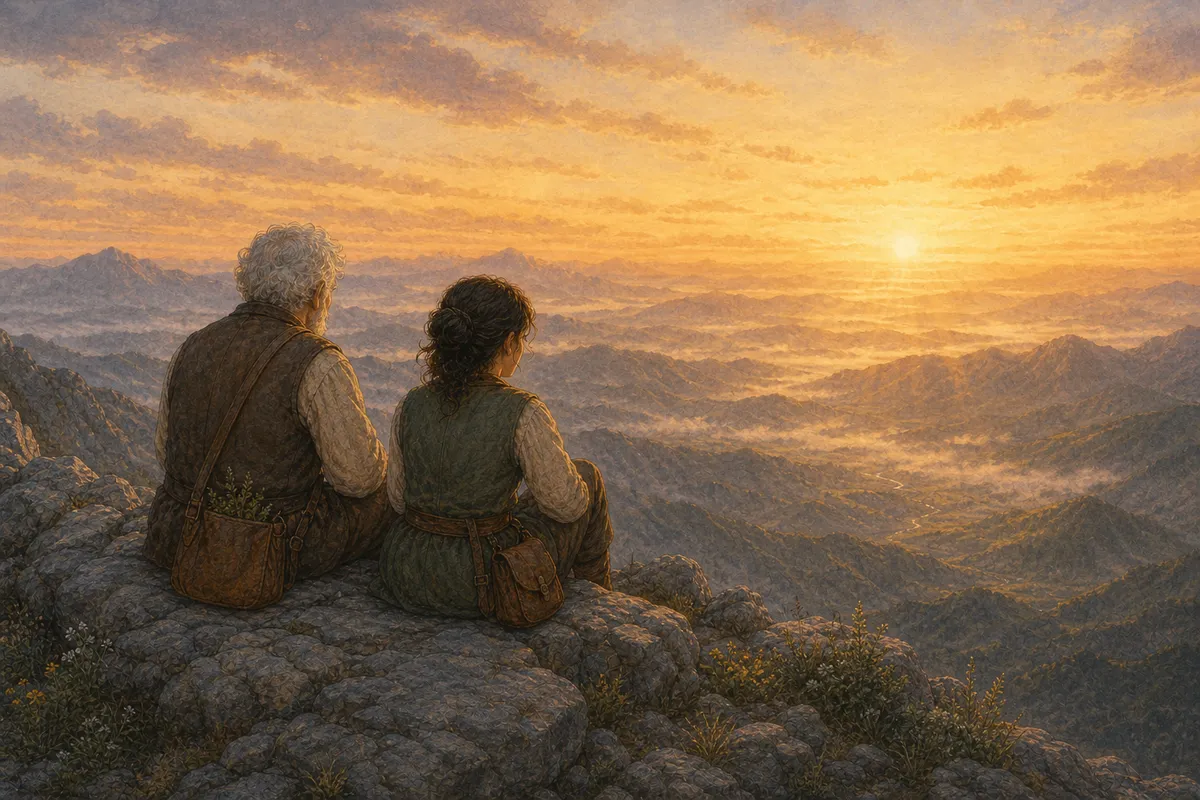
“Summit Sunrise.” Quill sat back on her heels, brushing the soil from her palms, and for the first time that morning looked past the trees, toward the east, where the sky had gone the color of a bruise just beginning to heal. “There's a high place, days from anywhere, where the road climbs above the tree line and you can watch the whole world catch the first light before anyone below has woken to it. He'd always wanted to see it once from the top instead of the middle distance. He asked me to take him the summer his breath had gotten bad enough that I think he already knew.”
“You took him.”
“I took him. Slowly. It cost us three days what should have cost one, and I never once told him so.” She was quiet a moment, turning the empty clay pot over in her hands. “We reached the top an hour before dawn and sat with our backs against the same stone and waited, the way you wait for a thing you both know is the last of its kind, without either of you saying so aloud. When the light came up over the ridgeline, he didn't say anything grand. He only said, 'Well. That was worth the knees.' And laughed — properly laughed, the way I hadn't heard him laugh in a year.”
Marrow said nothing. She had learned, across four winters of watching this woman garden in silence, that the kindest thing she could offer here was the same not-asking Quill herself practiced on every root and every guest.
“We came down the mountain that same morning,” Quill said. “He was tired, but glad-tired. We made camp below the snowline. And in the morning—” She paused, and her hands, Marrow noticed, had gone still over the pot for the first time. “In the morning, he simply hadn't woken. There was no pain in it, that I could see. He looked, if anything, like a man who'd finished something.”
Grief, tended like a garden, does not have to end. It only has to keep growing.
“I buried him where the snowline starts,” Quill said, “because he'd have hated to be carried down and put in a box in some town he never chose. Then I walked, for a long time, not really toward anywhere. And I ended up, the way people sometimes do, at a door that happened to be open — the Dawn Cloister, up on its quiet hill, where the sisters keep gardens instead of roads.”
“You stopped traveling.”
“I stopped needing to be anywhere in particular. There's a difference.” She reached into the empty basket at her hip and drew out a small paper twist of seed, setting it beside the yarrow as though she meant to plant that too, some other day. “He taught me plants heal in their own time, not in ours, and that the healer's whole art is patience dressed up as skill. I found I wanted a garden that stayed in one place long enough for me to prove I'd learned that. The cloister gave me one.”
“And the walking down here, every few months. The gathering.”
“That's not the cloister's discipline. That's mine.” For the first time, Quill smiled fully — small, but entire. “Every place I've stopped since he died, I've planted something he loved. A cutting in a hedgerow outside a market town. Seeds along a pilgrim road. Yarrow in a monastery kitchen garden the sisters still think grew there wild.” She looked down at the small mound of turned earth in front of her. “He isn't in one grave on a mountainside, Marrow. Not anymore. I made sure of that, year by year, without ever quite deciding to.”
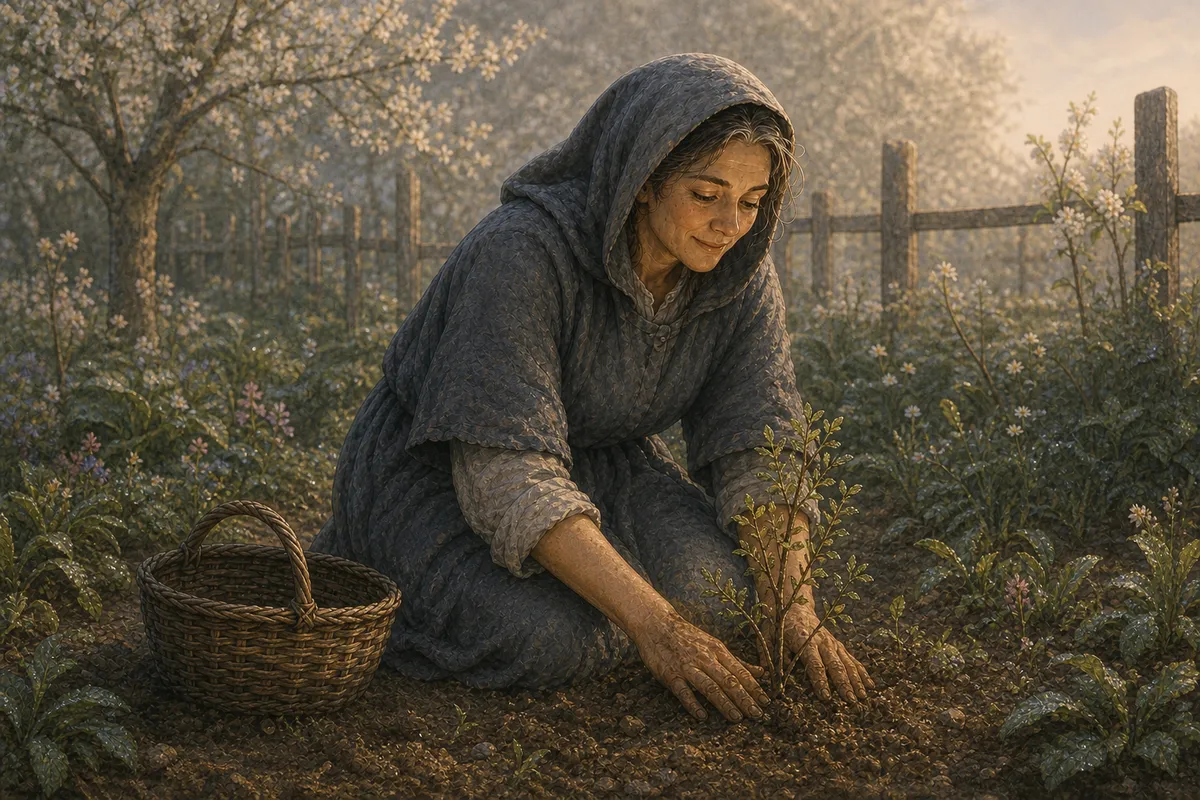
The east had gone from bruise-colored to rose by the time she finished, and somewhere past the orchard wall a cockerel remembered its job and started up, three mornings late as always.
Quill stood, brushed the last of the soil from her knees, and looked down at the small planted thing, no taller than a forearm, that would in a few years' time be taller than either of them.
“Will you come back to see it flower?” Marrow asked.
“I always come back to see them flower. Eventually.” Quill lifted her basket — empty of cuttings for once, since she had come only to give, not to take — and settled the strap over her shoulder. “That's rather the whole of it, isn't it. You don't plant a thing to watch it only once.”
She left the way she always left, before the first guest had stirred, up the orchard path toward the cloister road with the sun now fully at her back. Marrow stood a while longer at the gate, then went in and, before she banked yesterday's coals and started the morning's bread, took down her book — the thick, soft-cornered ledger that holds the inn's whole memory in ink — and wrote, in her small even hand, that a woman who had once learned to heal on the road had come again before dawn, this time not to gather but to give; and that somewhere on a mountain called Summit Sunrise, and in an orchard by a valley inn, and in a hundred places between, an old healer's garden was still, quietly, growing.
Safe. And warm. And told.