The evening the harbor letter-carrier finally told his story, nothing announced it. No first snow, no first rain of the season — only an ordinary blue dusk, and the particular quiet of a man who has, for once, nothing to say.
Bly Tern arrived at Adventurer's Rest the way he always arrived: a little out of breath, satchel slung crosswise over his chest, boots still ringing with the last mile of road. But he came in without a word for once, which was so unlike him that Marrow Wren looked up twice before she trusted what she was seeing.
Everyone at the inn knew Bly a little, the way you know a spring that comes back reliably each year. He carried the letters no one else would — the far ones, the overdue ones, the ones folded so many times the crease had gone soft as cloth. He arrived cheerful even in bad weather, because, he liked to say, someone at the other end of every letter was about to have a good day, and he got the best seat in the world to watch it happen.
Tonight he set his satchel down like it weighed more than it looked, and said nothing at all.
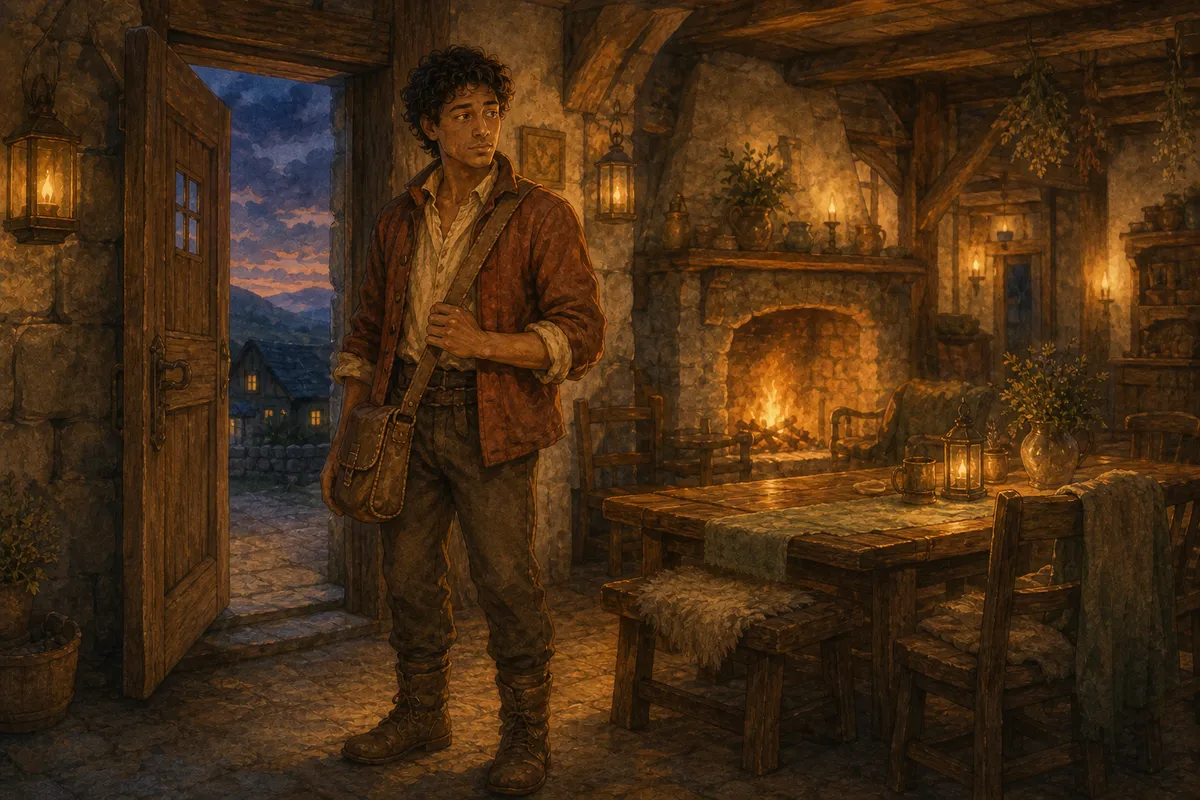
Marrow set the soup in front of him and did not ask what was different. It was some time before he spoke, and when he did, it was to the fire rather than to her.
“I finished a delivery today,” he said. “One I've been carrying a long time.”
“That's your work,” Marrow said. “You finish deliveries.”
“Not like this one.” He turned the satchel inside out to show her a small pocket, sewn shut on three sides, its leather gone pale and thin where something had sat pressed against it for years. Empty now. “I've had a letter in that pocket for six years. Longer than I've had most of my own memories straight. Tonight I finally put it where it was supposed to go.”
He did not perform, the way the young mapmaker once had. Nor did he speak low and careful, the way the fence-mender had, that first snow. Bly's story came out sideways, in fits and starts, the way a man tells you about a wound he's still deciding whether it's closed.
“I was young when I got it,” he said. “The satchel and the letter both — a going-away gift, from the woman who trained me on the harbor road. Her knees had gone bad on the cliff paths, and she was handing off what she called her unfinished roads. Most of it was easy — a debt here, a wedding invitation there. But at the bottom of the bag was one letter, sealed in a wax nobody uses anymore, so worn at the corners you could barely read the direction. All it said was: for the one who keeps the light at Beacon Dusk.”
“She told me what she knew of it, which wasn't much. A woman had written it near the very end of her days and pressed it into my teacher's hands with an urgency my teacher never forgot — asking, more than once, are you certain it will get there. My teacher promised. Then her knees failed her before her promise could, and the letter sat. Years, it sat, passed hand to hand along the coast road, always meaning to go, never quite going. By the time it reached me, the woman who'd written it was already gone. I found that out early — I asked after her, the way you learn to ask about the people behind the oldest letters, and I was told, gently, that she'd died some winters back.”
He looked at his hands. “So I had a letter for a woman with no one left to send it from. Every year I told myself: next spring. The coast road's long, there's always a nearer letter to carry first, and — if I'm honest — I was afraid of what I'd be handing someone. A letter that late isn't good news dressed up slow. I didn't know if I'd be delivering a comfort, or opening something that had finally, mercifully, closed.”
“This week I finally went. I don't know why this week and not another — maybe I'd simply run out of nearer letters. Maybe I just got tired of holding a question I could have answered any time I chose to.”
He told it plainly after that, the way a man describes something he's turned over so many times in his head that it's lost its drama and become only true. The coast road out past Sunrise Harbor runs high along the cliffs before it drops to the point, and from a mile off you can already see the light — not lit yet, just the tower standing pale against a sky gone the color of a healing bruise. He stopped twice on the way to make sure the letter was still there, though of course it was; a thing sewn into a pocket for six years does not slip away in an afternoon.
By the time he reached the tower, the keeper of Beacon Dusk was already climbing the inside stair with her lamp oil, the way she had climbed it, he learned later, every evening for eleven years — rain, fog, fair weather, no difference. Some lights are lit because ships need them. This one, he came to understand, had also been lit for reasons that had nothing to do with ships at all.

“She wasn't surprised to see a letter-carrier at her door,” Bly said. “People write to lighthouse keepers more than you'd think — supply orders, relief schedules, the odd fan of the view. So she took it easily enough at first, the way you take any letter, her thumb already moving to break the seal.”
“Then she saw the wax.”
Her whole face changed, he said — not into grief, not right away, but into a stillness, the particular stillness of someone recognizing a hand they never expected to see again. She asked him, quietly, where he'd gotten it, and he told her the truth: that it had come to him already old, already sealed, and that it had never once been opened by anyone but her.
“I told her I was sorry it was so late,” he said. “I'd rehearsed that apology the whole walk up. I was ready for her to be angry. Six years is a long time to sit on someone's last words.”
“And?”
“She wasn't angry.” He shook his head slowly. “She held it a long moment without opening it — just held it, the way you'd hold something you'd been told for years didn't exist. Then she said — and I'll remember this the rest of my life — she said, 'Well. It found me anyway.' And she asked me in for tea, like the wait had never happened at all.”
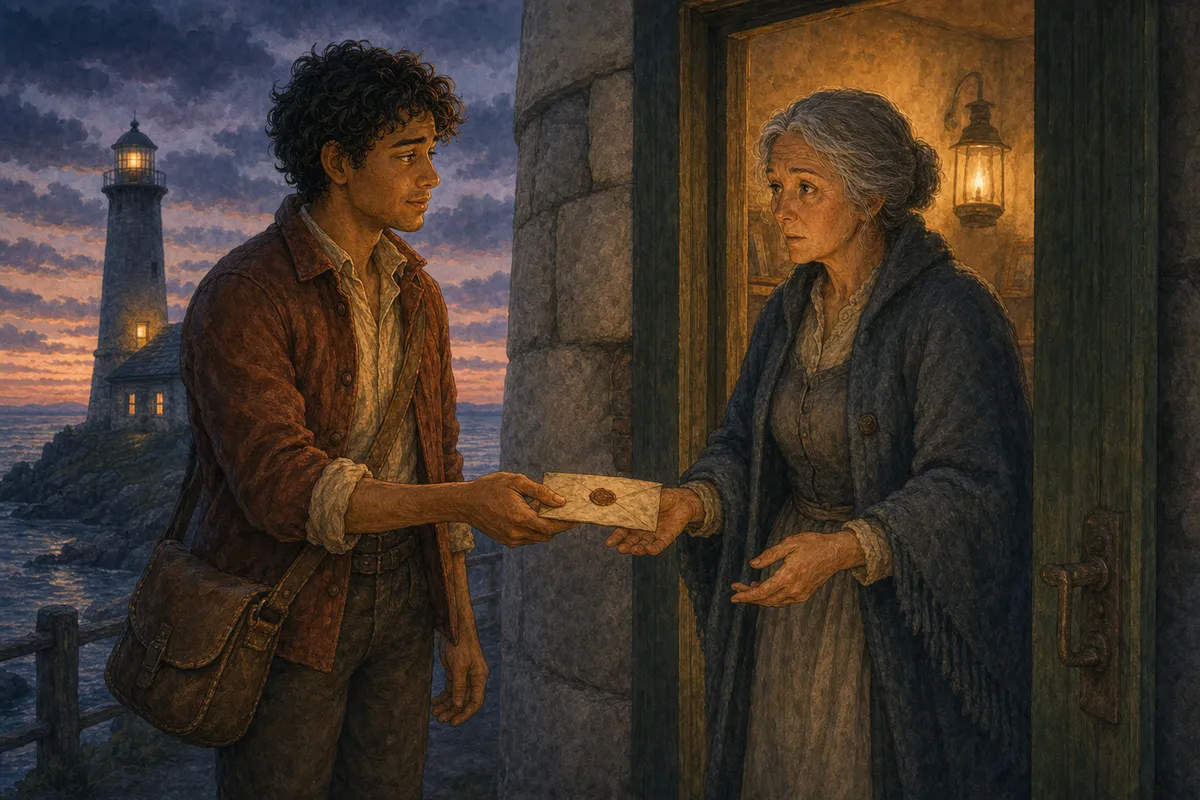
He did not read the letter to Marrow — that much, he said, was not his to give away, a moment strictly between two people meeting one last time across a gap no road could close. But the keeper had told him a little of what it said, once she had read it through twice in the lamp-room while he waited below with the tea going cold in his hands.
It was short, she'd told him. It was from her sister, who had left the coast decades ago, in the last loud year before the wars ended, meaning to write and then, somehow, never managing to — not out of forgetting, but out of a shame that only grows heavier the longer it's carried, until its size seems to make repayment impossible rather than merely overdue. She had meant to come back. Then meant to write instead. Then, for years, meant to do both, until meaning to was easier than doing, until an entire life had happened in the meantime — a life the keeper would now never hear the small true things about, because there was no time left for those. Only for this one folded page.
What the letter said, in the end, was very little. That she had never stopped thinking of the light on the point. That on the nights she couldn't sleep, she told herself it was still burning, and that this — knowing the light was lit, whether or not she could see it — had been enough to let her rest. That she was sorry it had taken her the whole rest of her life to say so. And that whatever else had gone unfinished between them, the keeping of that light had not been wasted. Not on her. Not once, not ever, in all the years she hadn't come home to see it.
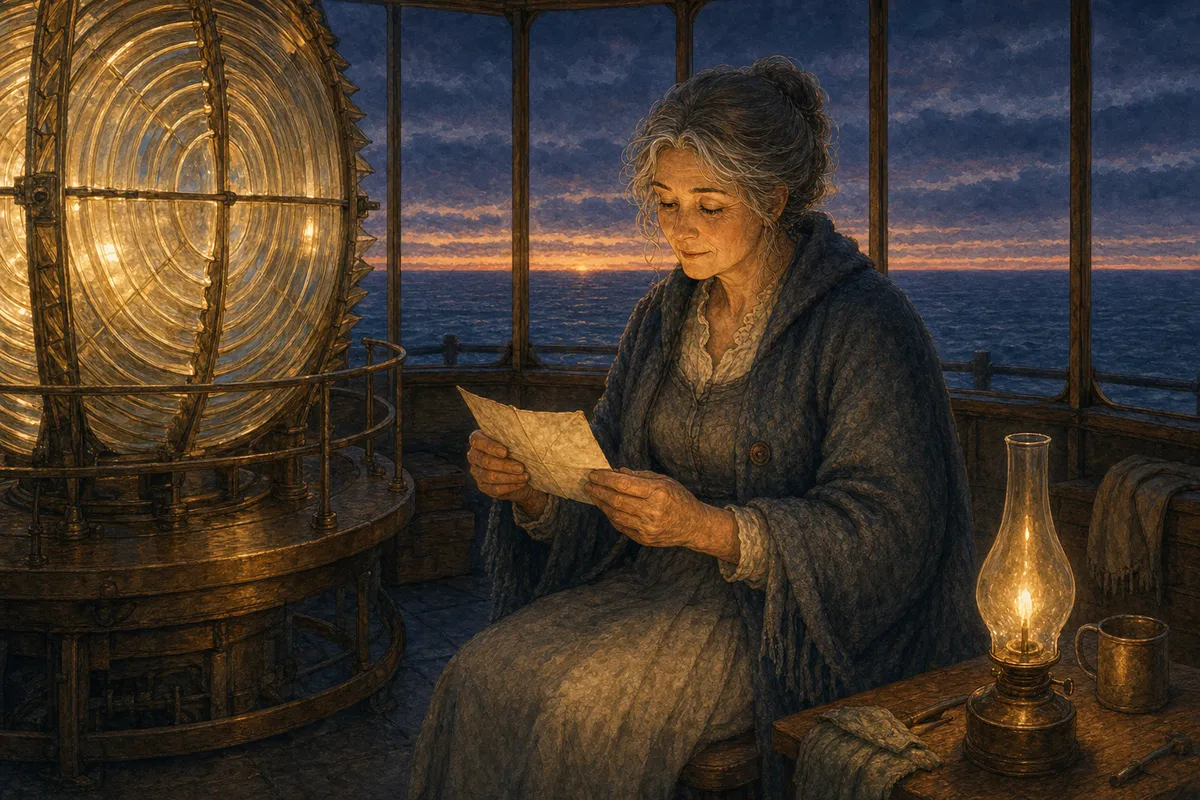
“That was all,” Bly said. “No apology big enough to fit the years. No explanation that would have made it hurt less if it had come sooner. Just — the light wasn't wasted. Keep it.”
“It didn't arrive the way anyone would have hoped,” he said. “Not in time. Not to a reunion. Not the way any of us would have chosen, if we'd been asked. But it arrived.”
Delivered, all the same.
The keeper walked him partway down the cliff path herself, blaming it on the tea having gone cold, though they both knew that wasn't really why. At the gate she thanked him properly — not for the years he hadn't caused, but for finishing what someone else had started, for treating six years of delay as no reason at all to stop caring whether a promise got kept.
“She said something else, before I left,” Bly told Marrow, and here, for the first time all evening, something in his easy voice caught. “She said, 'You must get to see this a lot — people getting news they've waited half a lifetime for.' And I said, yes, more or less, that's the job. And she looked at me — really looked, the way she'd looked at the wax seal — and asked whose door I go home to, after I've knocked on everyone else's.”
He laughed, a little unsteadily. “I didn't have a good answer. I'd never needed one before tonight.”
Marrow let the words sit, the way she let all the important ones sit. Outside, the wind had died down to nothing, and the fire had burned to the low steady gold it keeps at the end of a long telling.
“You're not simply a man who delivers other people's reunions, Bly,” she said at last. “You're one who makes sure nothing that's owed goes unfinished, even when it's hard, even when it's already too late to do it comfortably. That's not a small thing to be.”
Bly looked into the fire for a long moment, his satchel still open at his feet, its worn pale pocket empty for the first time in six years. “I've always liked my work,” he said. “I just never thought about what it costs, being the one who's always arriving with someone else's good news.”
“Then let this be the one delivered to you,” Marrow said, and set a second bowl of soup where the first had gone cold. “You did a kind and difficult thing tonight. It mattered. Sit by the fire a while — you don't have anywhere else to be.”
He did.
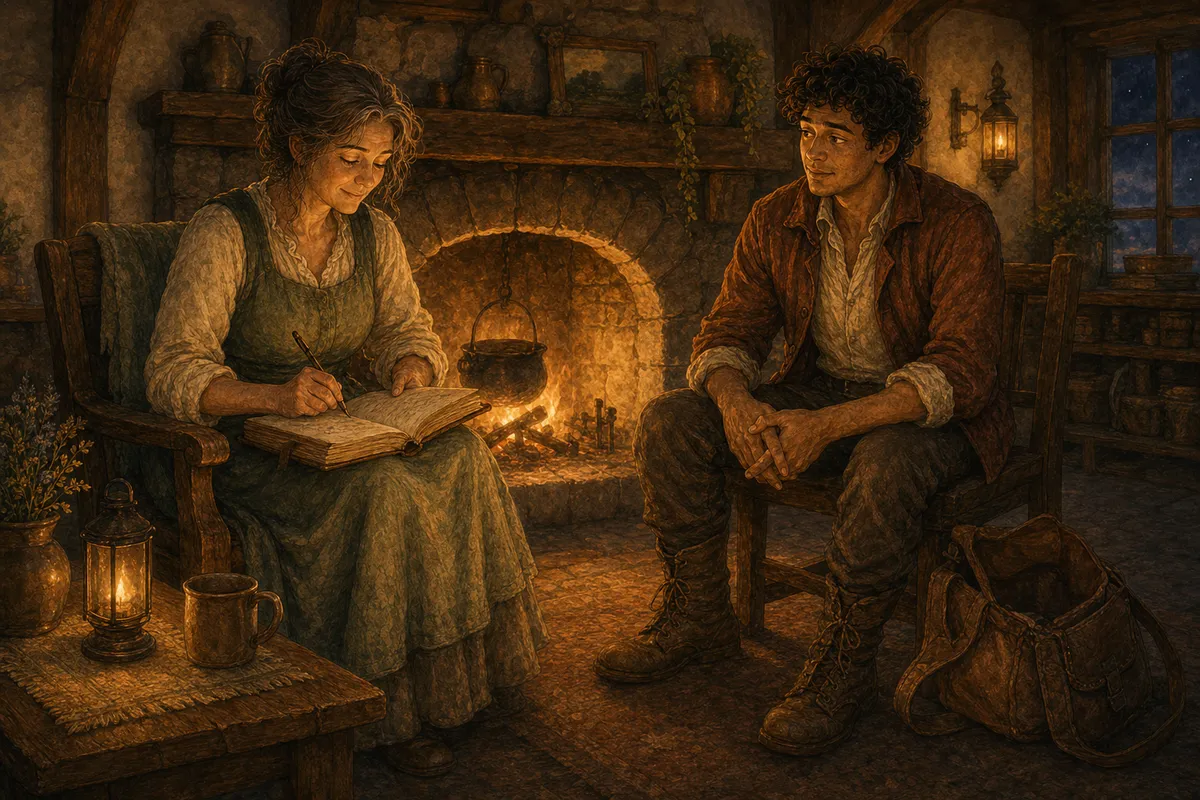
Later, when the inn had gone quiet and Bly had finally, gratefully, run out of things to carry, Marrow took down her book — the thick, soft-cornered ledger that holds the inn's whole memory in ink. She did not write the dead woman's name, which was not hers to record, nor the years the letter had waited, which no longer mattered now the waiting was over. She wrote only that a letter-carrier had finished the hardest delivery of his life, and that a light on a distant point was burning tonight for exactly the reason it always had — and that, for once, someone had come home to the inn carrying nothing at all, and had been glad, at last, to set it down.
Safe. And warm. And told.