The rain had been coming down since noon, the ordinary long rain of autumn that has no opinion about anything and no plans to stop, and Coll Ashford was building the fire up when the front door — the front door, which nobody used, which the wind sometimes rattled and nothing else ever touched — came open on its latch, and a very wet Sister Quill came in with a large covered basket held against her hip like something that might spill.
Marrow Wren looked up from the hearth, took in the basket, the door, and the state of the boots, and said, after a moment, “You know that's the front door.”
“I'd heard there was one,” Quill said. “I'll explain.”
Coll took the basket off her before she asked him to, and his eyebrows went up at the weight of it. “What've you got in here, the whole hill?”
“About a quarter of it.”
She sat down on the low stool by the fire without being told she could, pulled off both boots one after the other, and stood them upside down on the hearthstones, where they began, almost at once, to produce a small and steady drip that Coll watched with the expression of a man doing sums about tomorrow's floor.
“I'd like a bed, if there's one going,” Quill said, wringing a fistful of wet hem over the hearthstones for good measure. “I know the price. I'll warn you now, it's mostly about grass.”
“Those are the good ones,” said Marrow, not looking up from the pot.
Nobody remarked on the four years. It had become, by now, one of the things the fire simply knew and did not need saying aloud — the way it knew Coll took his tea black, and that the third stair from the top complained if you didn't put your weight on the outside edge, and that Sister Quill had never once, in all that time, come through the front.
It had started that morning, hours before the rain came back, when the almoner sent her up one of the braes to the north for warm-stones. The guest-house beds would want them soon, before the frost properly settled in, and there was no shortage of hills that grew them.
“There's a good many like it,” the almoner said, not for the first time, tying the empty basket to her back. “Folk up there know half a dozen and argue over which is best. Take whichever one lets you.”
On the common land above the burn, a handful of neighbours were already out ahead of her, low over the turf with their backs turned to the weather, and not one of them straightened to see who was coming.
“Burn side's boggy,” one of them said, to the ground, by way of greeting.
“They're good this year, mind,” said another, to nobody in particular.
Quill knelt down among them and learned within the hour not to hunt for the stones with her eyes but to feel for them with her palm flat against the grass — cold, cold, and then, without any warning at all, not. Overhead the light lay thin and faintly green, the same pale colour it always was on this hill and on every hill like it for a mile in any direction, and no one out on the common thought to remark on that any more than they remarked on the rain that had made it. It was only what the light did up here. Nobody up here had ever found a reason to be surprised by it.
The basket filled slowly, a stone at a time, and the neighbours worked their own patch of turf without ever quite working together, the way people do who have shared a hill for longer than anyone remembers deciding to.
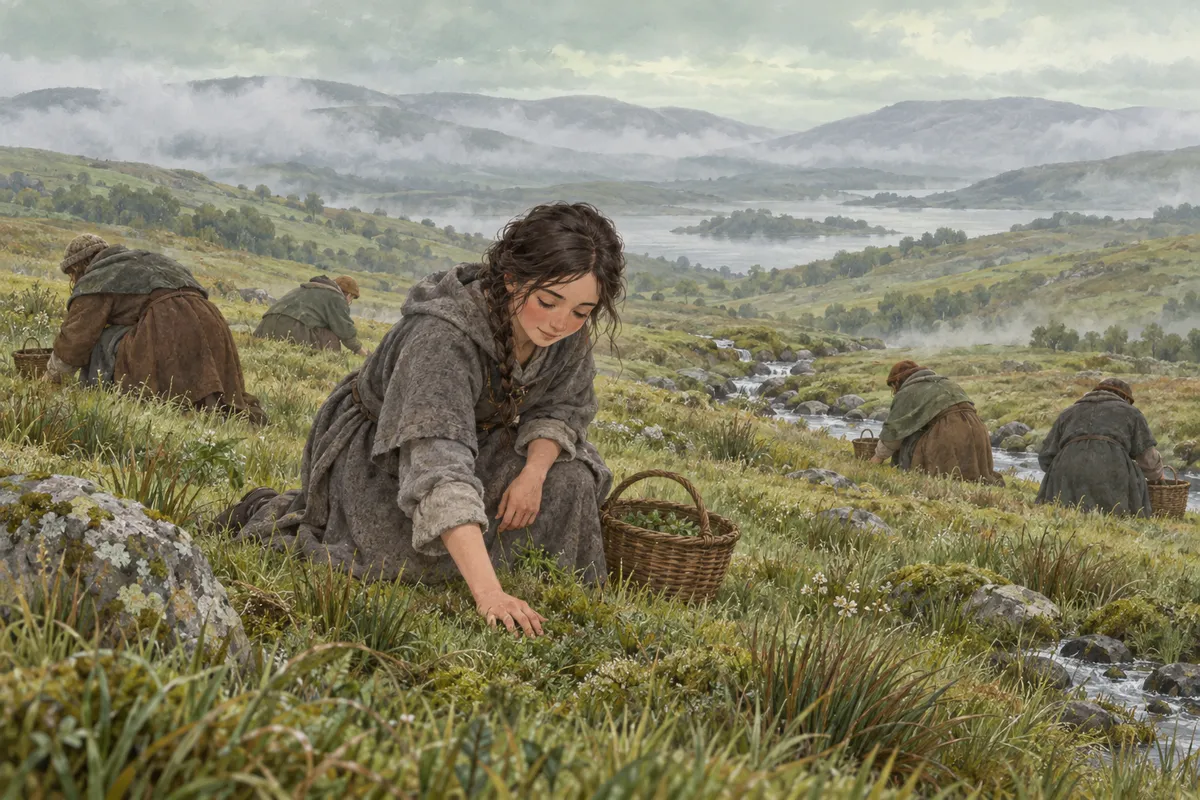
Her fingers had gone properly stiff by the second hour, past the ache and into the part where they stopped reporting much of anything, and she stopped to cup them low over the basket and breathe on them the way the almoner had taught the youngest sisters.
The neighbour nearest her, still bent, still facing away toward the burn, reached back without turning and pressed something small and round into her palm. “Put one in your pocket, Sister. They're warm in anyone's hand. They're not fussy.”
She laughed — the first sound anyone up there had made that wasn't about the weather or the ground — and did as she was told.
“Did you?” Marrow asked her, much later, at the hearth, when the walk came up in the telling.
“I'm a sister, not a saint.”
The stone in her pocket was still warm when she took it out to look at it, hours after she had stopped expecting it to be anything at all, warm the way a held hand is warm, not the way a fire is. By then the basket was half full — as much as any one person could reasonably carry down a hillside in the rain — and she stopped there on purpose, tied the cloth over the top, and turned for home.
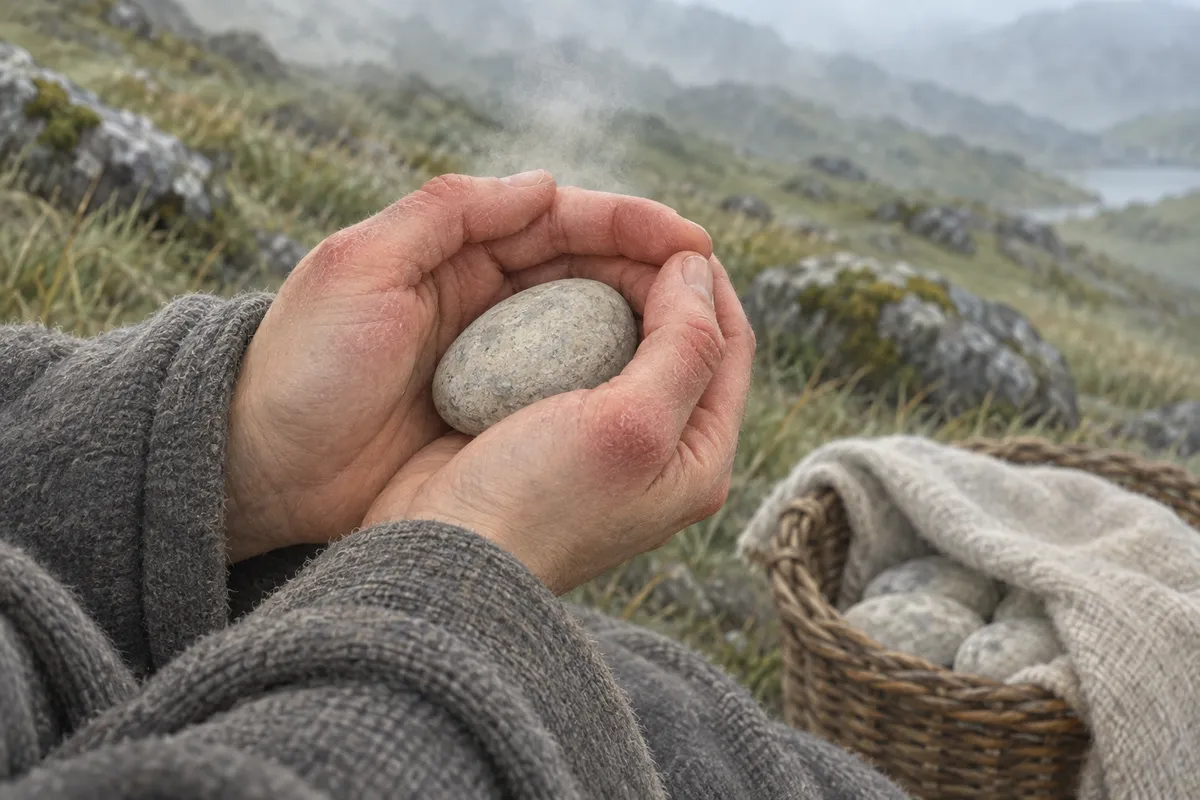
She had the basket up on her hip and had already half turned to go when the same neighbour — still crouched, still facing the turf, never once straightening — put a hand back over one shoulder and held something out to her the way you'd pass along a trowel without looking to see if the other hand was ready for it.
A folded letter.
“You'll be passing the crossroads inn, Sister?”
“I might.”
“Then take that, would you. For the letter-carrier — the harbour one. Cheerful. Never stops talking the whole way up the valley and half the way down it again. He brought us one in the spring and said he'd carry the answer back when there was one to carry. Well. There's one now.”
The face never came up, not once, through any of it. Quill tucked the letter under the cloth over the basket, down among the warm-stones where the weather couldn't reach it, and started down for the valley. The rain came back in earnest before she was halfway, and somewhere in the worst of it her boots stopped being boots in any useful sense and became, instead, two things that held rainwater and carried her feet around inside it.
By the hearth that evening, she worked the letter free — a little softened at one corner, otherwise whole — and held it out to Marrow. “So that's the front door explained. Letters go to the front door. Everyone knows that.”
Marrow turned it over and read the direction written on the front, and was quiet a moment longer than the sentence needed. “Care of the inn where the three roads meet.” Another pause. “Since when has Bly had a care-of?”
“Since this afternoon, sounds like,” Coll said, from the woodpile.
Marrow stood it up on the mantel, propped between two candlesticks where it would be the first thing anyone saw coming in. “He's due when he's due.”
“That's the story, then?” Marrow asked her, when the letter was settled and the boots had stopped their dripping.
“Grass, mostly. And one letter.”
“It's paid,” said Marrow.
Coll, eyeing the upended boots on the hearthstones with real doubt, said, “Those won't be dry by morning.”
“Then I'll just have to stay till they are.”
Marrow took a candle up ahead of her to show her the room — one of the newer candles, the kind that had only begun to live in this house since the last hard frost — and on the narrow stairs Quill said, “Half a day carrying one letter and my boots are ruined for it. I don't know how that boy stays so cheerful.”
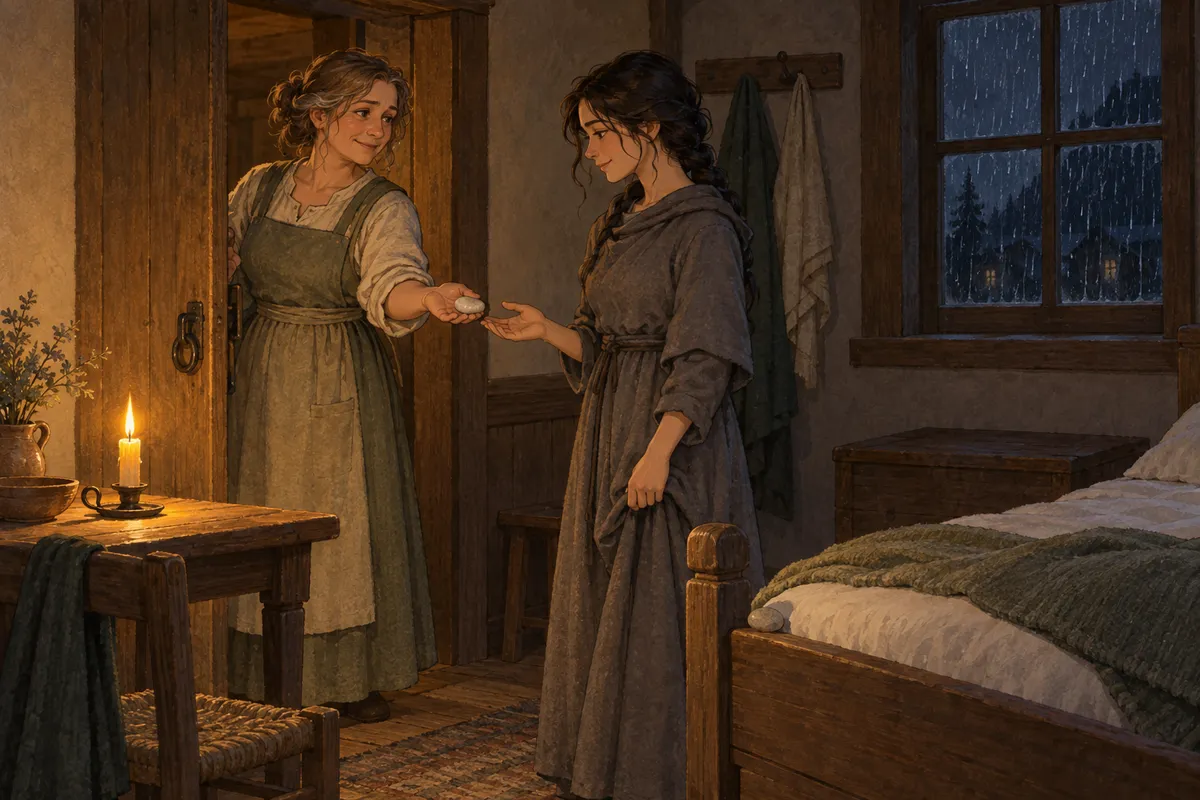
At the foot of the bed, under the folded blanket, a warm-stone was already waiting, and already warm.
“You put one in every bed?”
“Every bed, all winter. Cheap as eggs off the tray in town, and they don't need airing the way a bedwarmer does.”
“I picked about forty of these today,” Quill said, turning it over in her hand, “and never once thought about whose cold feet they'd end up under.”
“Cold ones, mostly,” said Marrow, from the doorway.
Before she left, Quill dug one more stone out from under the cloth in her basket and pressed it into Marrow's hand — for the ledger, and the fingers that would have to write in it before anyone else was awake. “Don't thank me. Thank the hill.” A beat. “Actually, don't bother. It won't notice either way.”
Marrow woke before the cockerel, as she woke every morning that year and most years before it, and went out of habit to the orchard gate. It was empty, the way it had been empty every morning for four years running, and would, by every reasonable expectation, go on being. “Ah,” she said, to nobody in particular, and went back inside to the ledger.
She was writing in it, one hand curled loosely around the stone Quill had left her, when Coll came in with an armful of wood and stopped at the sight of the covered basket still sitting by the cold end of the hearth.
“Where's—”
“Asleep.”
“It's gone sunrise.”
“I know.”
He carried the rest of the wood in on tiptoe, the way he had taught himself to over the years, and when one floorboard gave its single reliable complaint underfoot they both looked up at the ceiling at exactly the same moment, out of the same old habit. Setting the last log down by the fire, he noticed the letter propped on the mantel and stood looking at it for a while.
“Bly's got post.”
“Care of us, apparently.”
Coll considered this the way he considered most things, slowly and to the end. “I could put a nail up. Above the mantel. For his letters.”
“He's had one letter,” said Marrow.
“Might get another.”
Marrow did not answer that, but she did not tell him to take the nail down either, and Coll, who had learned to read her silences the way he read weather, decided that was answer enough for one morning.
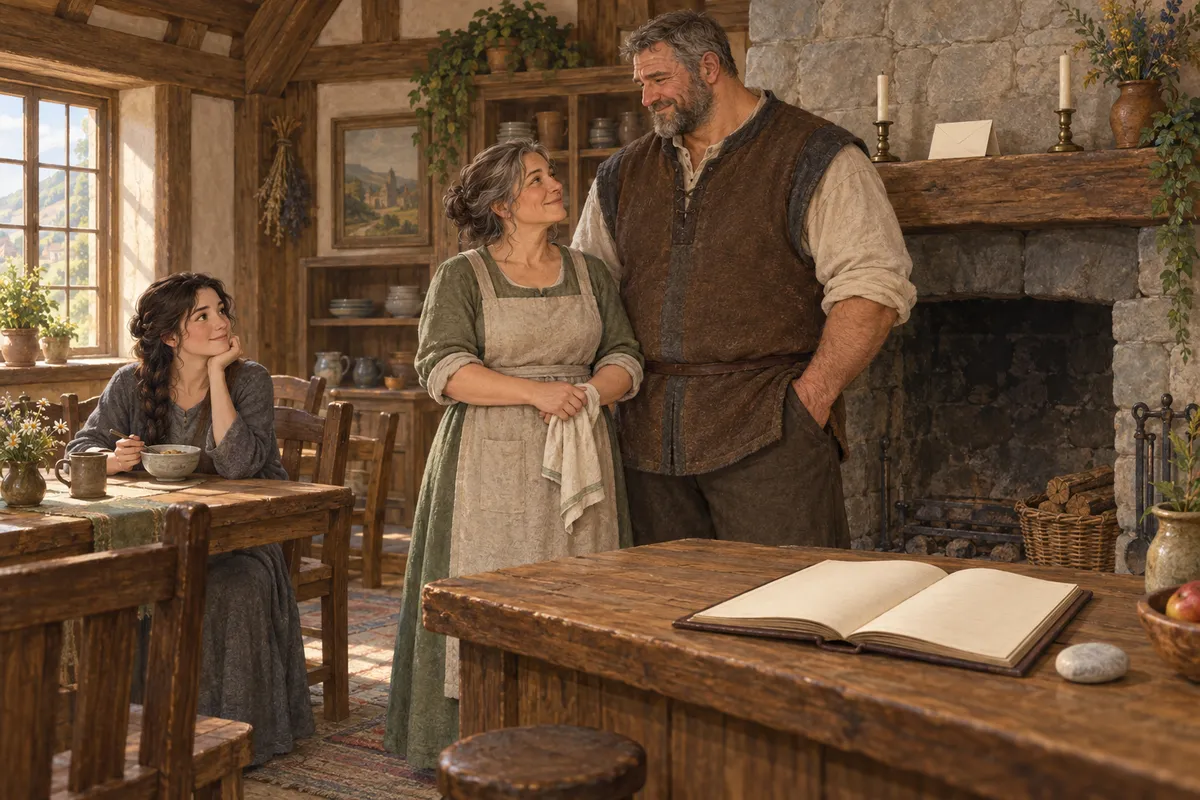
The cockerel crowed at last, three days late as usual, and by the time the sun was properly up over the yard Sister Quill came down the stairs with her hair only half out of its night-braid, blinking at the light in the windows as though it had arrived early on purpose.
“Why did nobody wake me?”
“Guests don't get woken,” Marrow said.
“The cockerel beat you,” Coll offered.
“The cockerel's three days late. That is a very low bar to clear.”
The first thing she looked at, before the fire, before the bowl Marrow had already set out for her, was the mantel. “Has he been for it?”
“Not yet.”
She sat down at the hearth for breakfast, which in four years she had never once done, and nobody at that table remarked on it, the way nobody had remarked on the front door the night before, or on the boots, or on any of the small quiet firsts a person is allowed to have in a house that keeps its ledger without keeping score.
Sister Quill, one night's lodging. Paid in a story that was mostly about grass. Slept past sunup for the first time on record; the cockerel did not beat her, though it did try. One letter, for the harbour letter-carrier, still waiting on the mantel between the candlesticks — the first letter this house has ever kept for him, and, it is generally agreed, unlikely to be the last.
“They're warm in anyone's hand. They're not fussy.”
Safe. And warm. And told.