The first guest of the winter arrived without a word in front of him, which is how Marrow Wren knew he was carrying something.
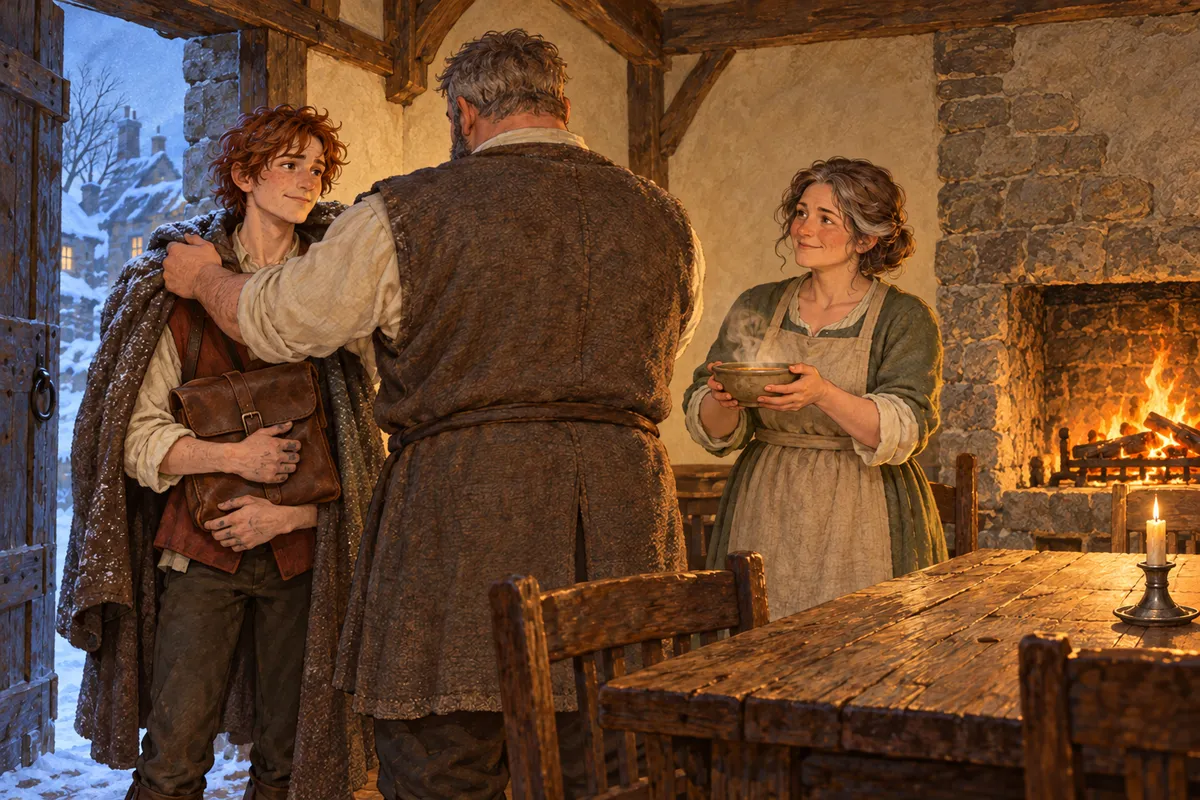
It was the first real cold of the year, the kind that comes in at dusk and means to stay, and the river road had gone white along its edges, and the inn's windows were already gold. Pip Lark came in off the road with frost on both shoulders and his leather map-case held against his chest like a loaf, and he shut the door behind him without apologising to it. In all his visits he had never once done that.
He had been gone a month, drawing Honeystane lane by lane, and had promised to be back before the snow. Coll Ashford took the frosted cloak off his shoulders before it could drip, hung it on its peg, and went out to look in on the grey, which was how Coll left a room kindly.
Marrow put a bowl into Pip's hands and let him stand there holding it. The candle on the long table was one of the new ones, the kind that had begun to live in this house since the last hard frost, and Pip looked at it a moment longer than a candle deserves, and then at nothing in particular, carefully, the way people do when they are saving up a sentence.
“Where did you start?” Marrow asked. It was the smallest question she owned, and she had been using it on him since his first wet night.
“Up the castle,” Pip said. “Before light.”
She nodded, as though that were an ordinary answer, and let him eat. Then he began, the way a mapmaker begins: from the top, and down.
It had gone like this.
A town is best drawn from above, and Pip had spent a month drawing Honeystane from underneath. So on his last morning he had gone up to the castle before light and asked, at a small door in the wall, whether anyone would mind a man at a window.
Nobody minded. The boy who rings the market bell was sixteen or so, long and thin, in a coarse undyed jacket, his cheeks already red with cold. “Mind the fourth stair,” he said, and went up ahead in the dark without a light, as people do on stairs they know. “Gran showed me the stair, the rope and the lamp, in that order, and complained the whole way. Her knees went two winters back.”
At the top was a small stone room with one window, and an oil lamp on the sill burning at working height, so bright in the glass that the town beyond was only a smudge. Pip asked whether it could go lower, and the boy said it could. He trimmed the wick, set two fingers to the cold brass foot the way you would to feel a sleeping dog breathe, and waited, and the flame went down to a bead and stayed.
Then the town came up in the window, roof by roof: slate silvered with frost, the pale walls not yet honey, a hill beyond the north gate just catching a little light, and from every chimney in the place a thin straight thread of smoke. Not one shutter was open.
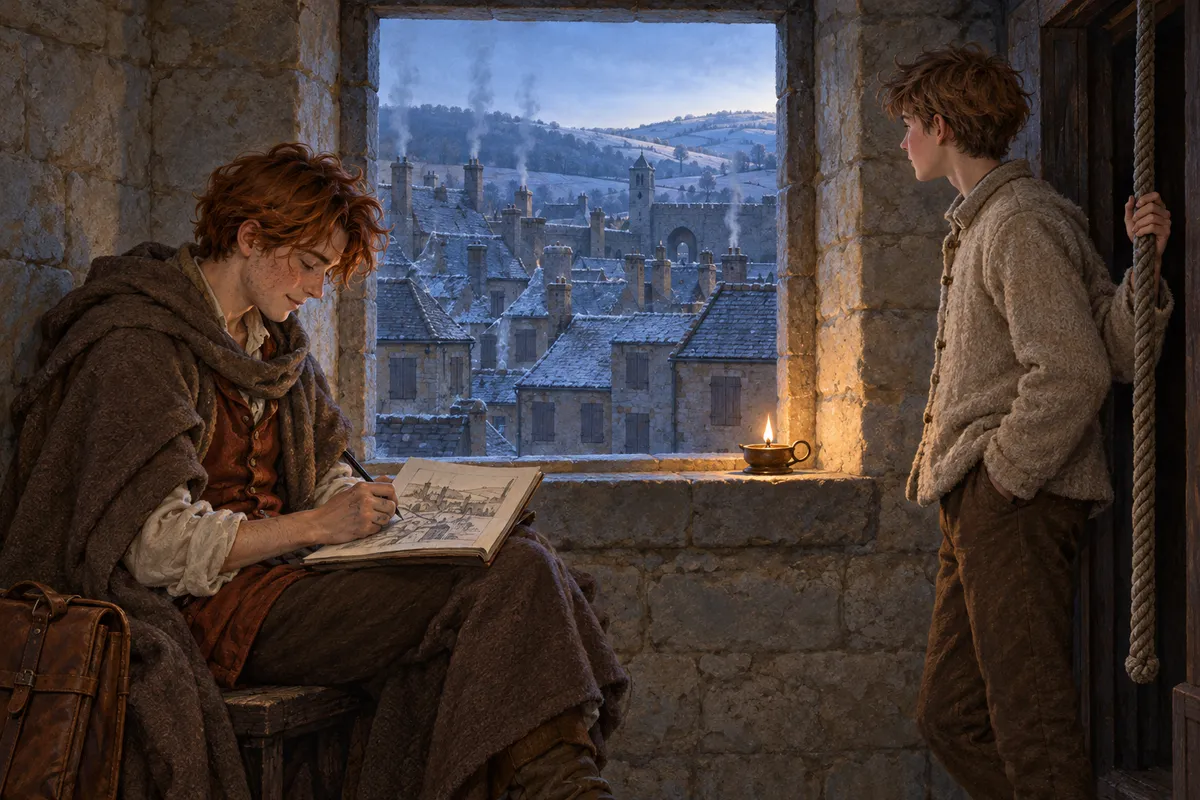
Pip, who had never minded anything warmer than ink, asked if he might snip the black crust from the wick himself, and was let. The flame leaned, shrank, and very nearly went out before the boy's hand came in and put it right. “Everyone does that once,” the boy said. “That part anyone can do. It's the waiting that takes two winters.”
“Could anyone learn it?”
“Anyone who'll stand there. Gran stood the baker's lad up here one winter, with his arm in a sling. Hopeless. He bakes well, though.”
The lamp came back up while they were talking. Nobody had touched it. By the time the sky had turned the colour of the inside of a shell, the flame stood at working height again, calm as a cat that has simply come back to its chair. “It does that now,” the boy said. “I put it down; it gets up again. I can feel it take. It just doesn't stay put.” He said it evenly. “It's not that I've lost the hand.”
“Every morning since the frost came in properly. Baker's the same. Farrier's iron's warm till noon.” He nodded at the smoking roofs. “Nobody's frightened. Everybody's mentioned it. Gran says the whole valley's waiting up for someone.”
“Who?”
“That's the thing. Nobody's expecting anyone.”
Then the sun reached the castle and the boy took the rope in both hands, and the bell went out over Honeystane — six slow strokes, and a seventh — and below, the first shutters began to open. “Everybody says it rings the market in and the dark in,” he said, when the last stroke had gone out of the stones. “Gran says that's all it was ever wanted for.”
The boy, still holding the rope, pointed with his chin at a chimney up by the north gate, standing over a narrow house squeezed between two wide ones. Its smoke was thinner than the others, and newer. “A week,” he said. “That house has been shut since before I was born.” And then, because Pip was looking at him: “That one's not waiting up. Somebody lit that one. You can tell — a kept fire looks tired in the morning. That one looks glad.”
By the time they reached the lanes the market was up, and the town had found a word for whoever it was — a word nobody in Honeystane had said aloud in living memory, and now nobody was saying anything else. They were tall, said the man at the cheese stall, who had never met one; they were short, said his wife, who hadn't either. They were as old as the castle, or younger than Pip. They were polite: the egg-woman's gran had said polite, and her gran's sister had said very.
Nobody was frightened. Pip, who had spent a month learning what a town looks like when it is afraid, thought this one looked shy. Nobody had knocked. Nobody was going to.
“What would you even say to an elf?” the egg-woman asked the whole stall, in the voice of a question that is mostly a laugh.
The farrier — the one Coll had taken the grey to in the autumn, broad through the shoulder in a leather apron scarred pale — stood a little apart with his arms folded. “Good morning, I should think,” he said. Everybody laughed. He did not.
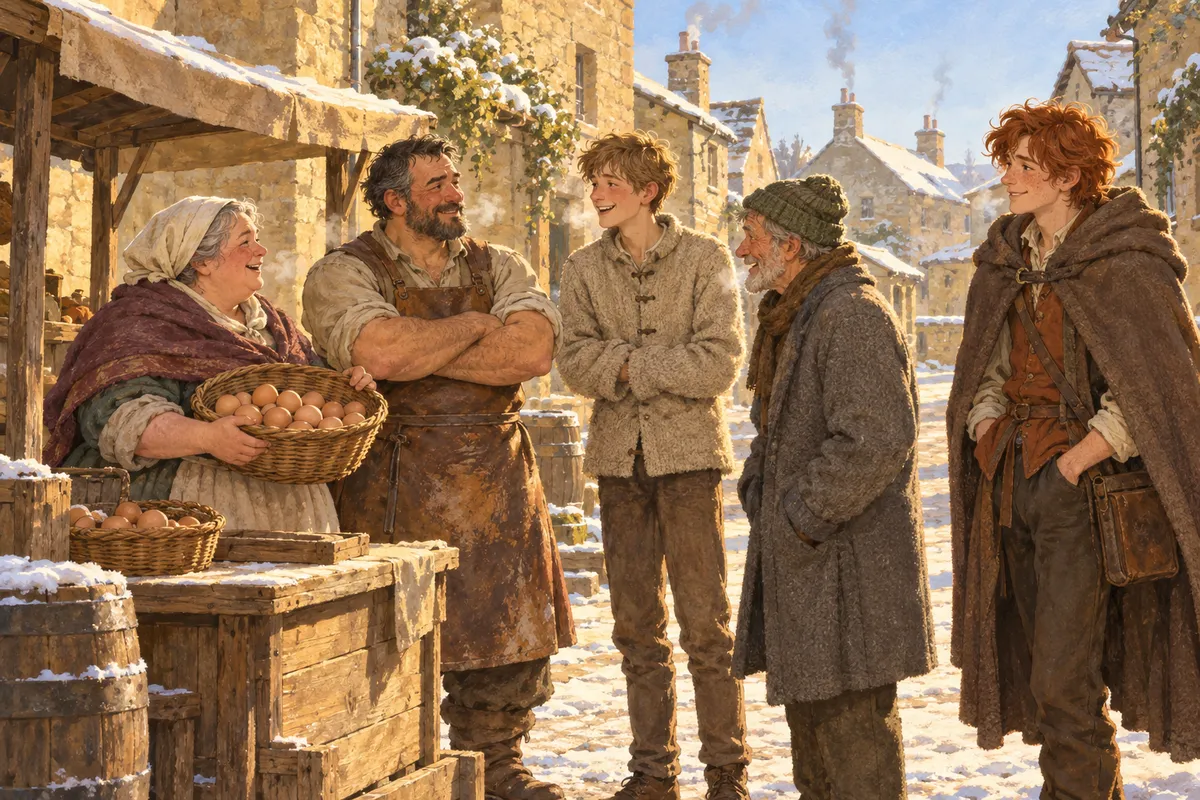
Pip asked him, remembering the iron, whether his own fire was behaving. “Banked mine at ten,” the farrier said, as flatly as a man giving the weather. “Up at five, looking at me.”
The boy, down for his breakfast, stood at the edge of the stall. “Gran says it's them the valley's been waiting up for. That's why the fires won't settle. Everyone's keeping a light in the window.”
Pip was a mapmaker; he put dates beside things. “The fires stopped settling a fortnight before that chimney was lit,” he said. “And they still won't, a week after. If the valley were waiting up for them, it would have gone to bed.”
“Then what's it waiting for?”
“I don't know,” Pip said. “That's what I wrote down.”
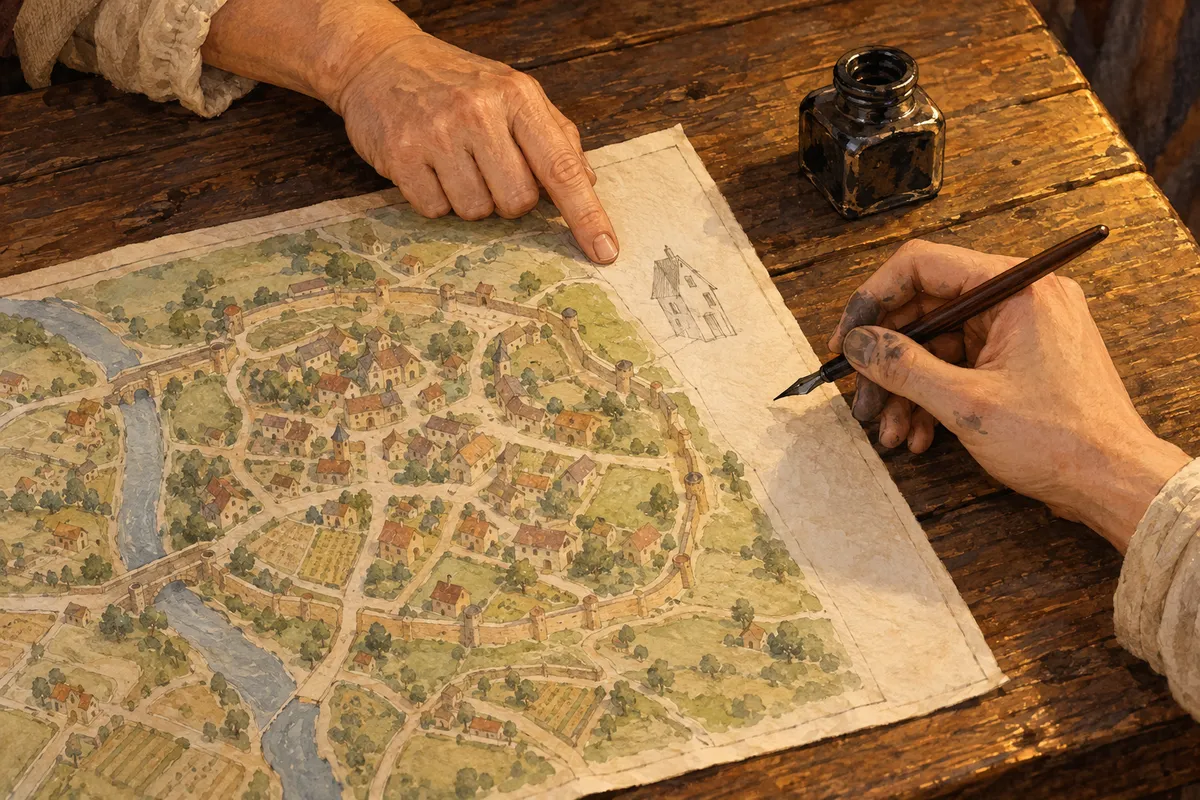
That night at the inn he spread the map on the long table. It was the first he had made of a place where he had stayed long enough to learn the names of the dogs: Honeystane in small green lanes and honey-coloured walls, and a little drawing of every door he had liked. By the north gate, between two wider houses, stood a narrow one, drawn in the lightest pencil he had, and beside it the margin was white.
“My master would put a small tower there,” Pip said, “and write watch beside it. That's what his kind of map does with a house it can't account for.” He turned the pen over. “I won't draw that.”
“But I can't leave it blank, either. Blank is what the old maps leave beside the places they'd rather not go.” He set the pen down. “And I can't write elf. I haven't seen one. All I know is somebody lit a fire.”
Marrow said nothing for a while. Across the table Pip's pen hovered over the paper and stayed there, waiting, as it had all evening. Then she set one fingertip, very gently, on the white of the margin, the way she had once set it on a blank cream place where three roads would meet, and she left it there.
“When I came to this house,” she said at last, “the valley had a word for me too. Several.”
She told it plainly, as she told everything about herself, which was seldom. In her first weeks at the inn, with the rooms empty and nobody yet knowing what to make of her, the valley had decided what she was. A widow. A woman who had run off with somebody's husband. A lady fallen from a good house. A smuggler — that one, she admitted, she had rather liked. None of it was ever said to her. It was said over her gate, to each other, and never once through her open door.
“And then one morning, in a hard frost, a woman from the town knocked.” She had walked an hour to do it. Her hands were blue. She said good morning, put a warm-stone into Marrow's palm, closed Marrow's fingers over it, and went home.
“She didn't ask me one thing,” Marrow said. “Not who I was. Not what I was doing here. I never found out who she was.” She looked at her empty palm. “I carried that stone about all winter. It was warm every time I took it out, and it never once wanted anything back.”
“But you ask,” said Pip. “Everyone who comes. It's the one rule.”
“I ask, here. It's the price of a bed. But nobody should have to pay to be said good morning to.”
Pip looked at the hearth. The fire in it was bright and upright and, now that he thought about it, rather alert. “Is yours doing it too?”
“Since the frost. I put it down every night, same as ever. It takes. It just won't stay down.” She said it the way she might have said the gutter wanted clearing.
Pip went up to bed with the margin still white, and since guests don't get woken, nobody woke him.
Marrow took down the ledger and wrote what was known: Pip Lark, one night's lodging, paid in a story about a chimney. The fires of the valley will not settle, and nobody knows why, and nobody is afraid. In Honeystane, near the north gate, someone has lit a fire in a house that was shut, and the mapmaker drew no wall beside it. She did not write the word the town was using. A ledger is for what you know.
Then she went to the hearth, as she did every night. The fire was sitting up in the grate, as it had every night for a fortnight — not roaring, not sinking, only awake, and looking at her. She looked back for a while.
“Let it wait up,” she said, to nobody in particular. “Someone's always on the road.”
In the morning she took a warm-stone out of the basket by the hearth and put it into Pip's hand, where he stood in his cloak with sleep still on him. “Will it last as far as the north gate?” he asked.
“It's a warm-stone,” said Marrow. “It needs no one to mind it. It'll be warm in whoever's hand it ends up in. They're not fussy.”
He unrolled the map one last time and, in the white beside the narrow house, in the smallest hand he owned, wrote: here, someone has lit a fire. knock, and say good morning. Marrow read it upside down, the way she read everything on that table, and said nothing at all, which from Marrow was praise.
Then he rolled the map, put the stone in his cloak pocket, where it stayed as warm as a held hand, and went out onto the river road.
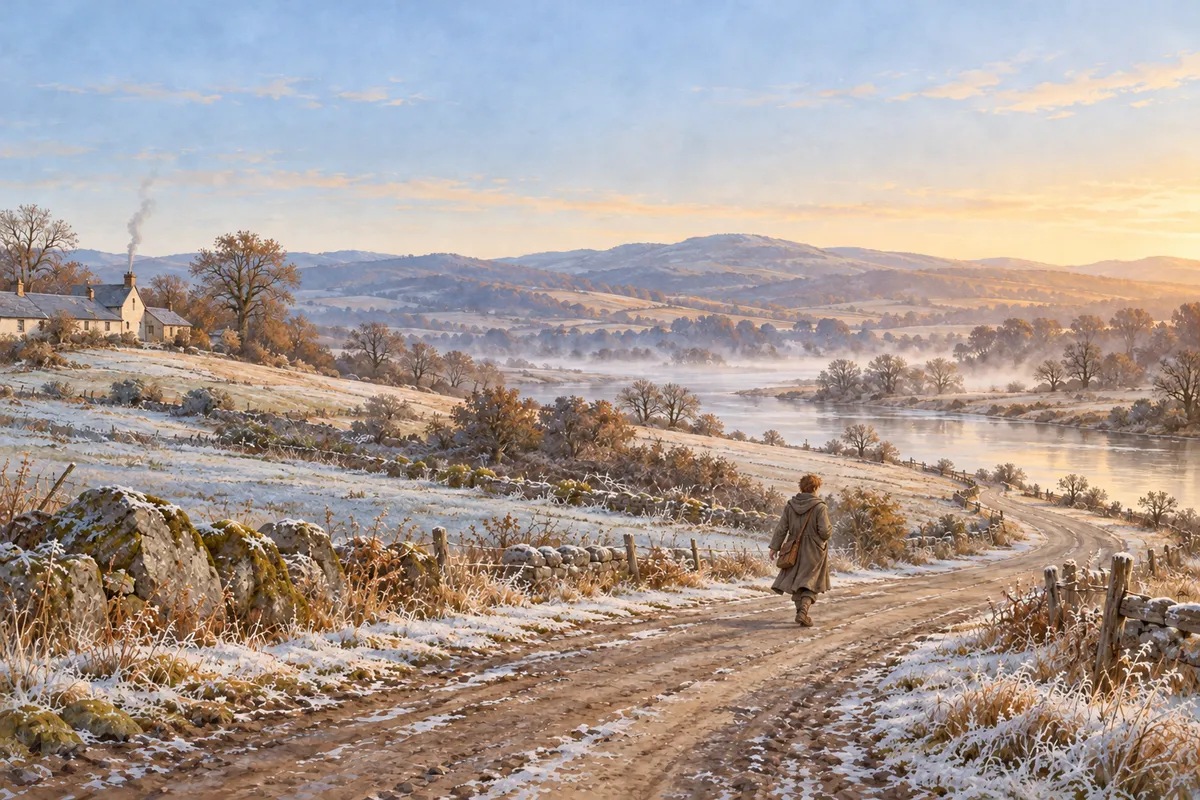
What was said at the door by the north gate is another night's story. The inn, which has lately taken to waiting up, will keep a light in the window for it.
Some things take two winters of standing there. Good morning takes none.
Safe. And warm. And told.