The first snow of the year came down soft and unhurried, the way snow falls when it has decided to stay.
It found the valley quiet. The roads were empty, the way they go in the deep of the year, and the inn was between guests. Out past the kitchen garden, in the failing blue light, a very large man was mending a fence. He had been mending it, on and off, since October.
His name was Coll Ashford, and he had come to Adventurer's Rest a little over a year ago and had simply never left. He had asked for a bed and offered to earn it, and Marrow Wren — who had a good eye for the difference between a man running from something and a man who had finally stopped — had handed him a hammer instead of asking for a story, and let him stay.
He was enormous, slab-shouldered, with forearms like fence-posts, and yet there was nothing heavy in the way he worked. He mended the gate, then the shutters, then the stable door, then the gate again, and when nothing was left broken he found things that were not quite broken and improved them. Marrow had watched him through a full turn of the seasons, and had come to understand that Coll Ashford was not really fixing the inn. He was keeping his hands too busy to sit still by the fire.
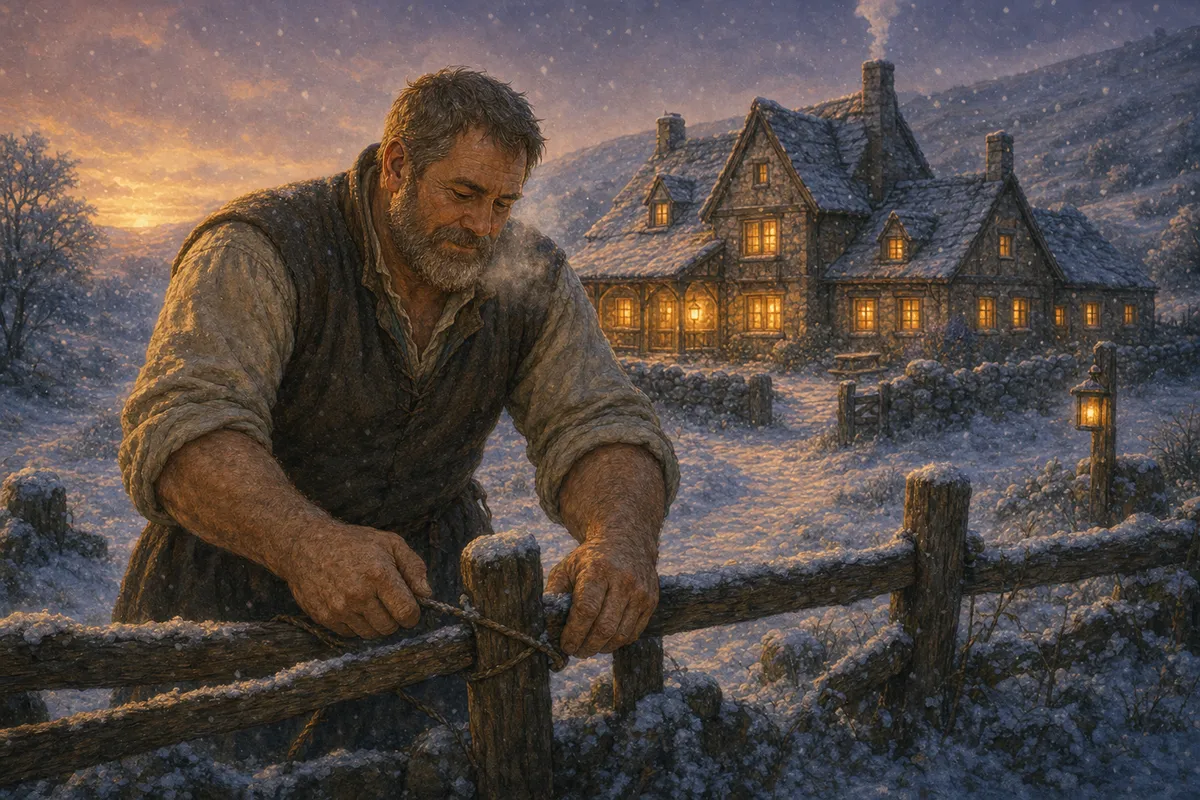
For there is one rule at Adventurer's Rest, never spoken aloud and always understood: every guest pays for their bed with a tale of the road. Coll had paid in fence-rails and split firewood for a year, and in all that time he had never once told his story. Marrow had not asked; she had a patience deeper than most weather. But tonight the snow was coming down the way it does only a handful of nights a year, and for the first time she set out two bowls of soup instead of one.
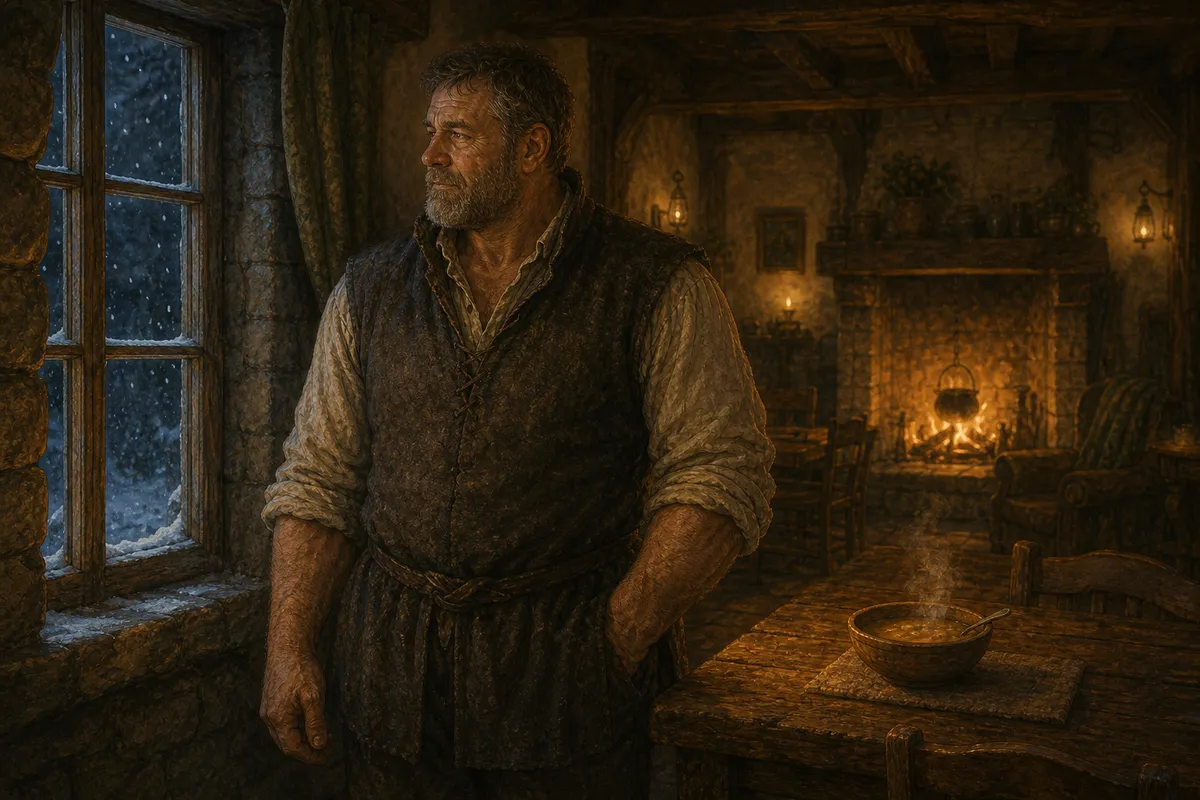
When the dark finally drove him in, Coll stamped the snow from his boots and stopped just inside the door. He had meant to say something about the fence. Instead he stood very still, looking past her at the window, where the snow fell slow and silver against the black glass — the warmth of the room at his back, the cold at the glass, as though he could not decide which one he belonged to.
Marrow set the second bowl down across from her own. “It looks like a place,” she said. She did not say which place. She only meant the snow.
Coll was quiet a long moment. Then he came and sat, because the soup was there and because she had not asked him anything, and the not-asking was somehow the thing that opened him.
“It looks like the last place I ever fought,” he said. He turned the bowl slowly in his big hands and did not eat.
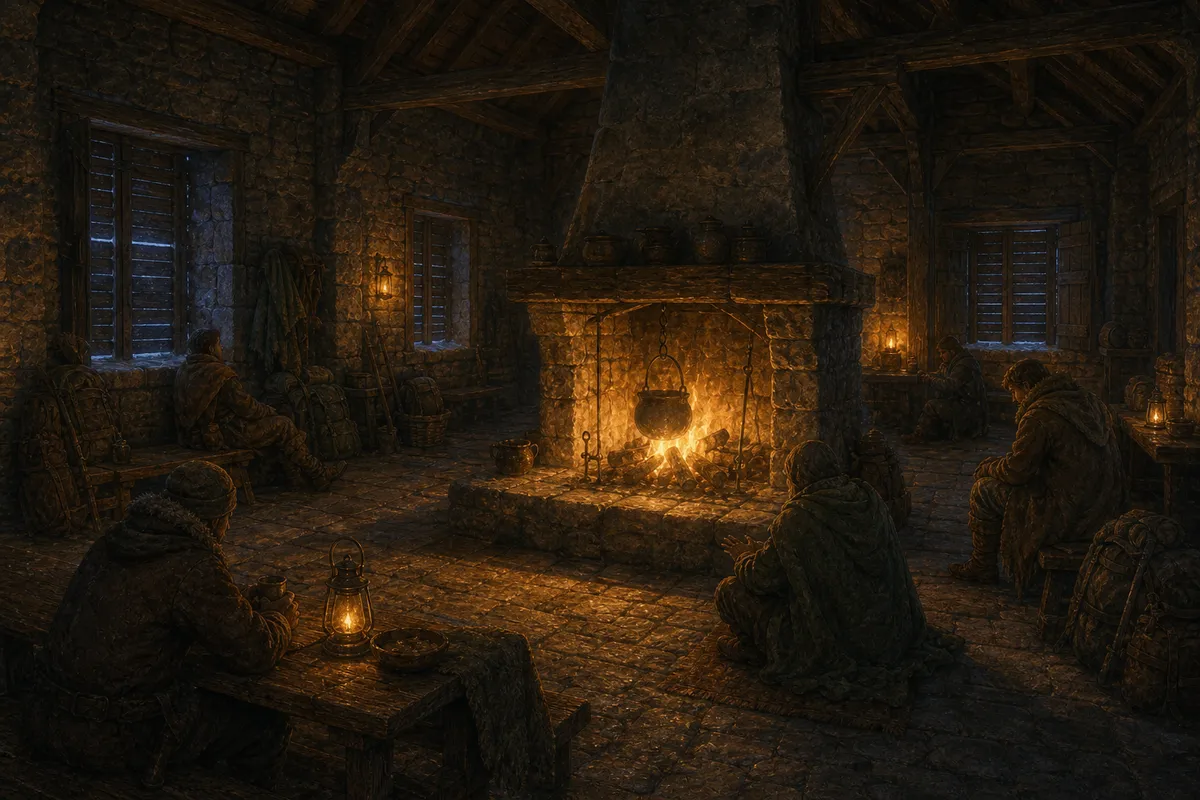
“It was the far north — the end of the loud years, though we didn't know they were nearly done. There was a waystation up past the snowline, a stone hall with a hearth in the middle of it, built for a country where winter is the thing most likely to kill you. The last of our company holed up there. Word had come that something was coming over the pass; someone had to hold the hall, and that someone was us.”
He was not performing the way the young mapmaker had performed, that rainy autumn night a season ago. He spoke low and even, laying the words down carefully, like a man stacking wood he was afraid might fall.
“I want you to understand what I was. I was good at one thing, and I'd been good at it since I was a boy, because it was the only thing that kept me alive. After enough years a man stops asking whether the thing he's good at is worth being. I was the one they put at the front. I never broke. That was my whole name in the company — not Ashford, just: the one who holds.”
“So we waited in that snowbound hearth. Three days. Four. We slept in our boots, and every gust off the mountain, I had my hand on the hilt before I was awake. On the fifth day a rider came up the white road, half frozen, and we made ready — and he wasn't the enemy. He was one of ours, days late, and what he carried wasn't a warning.”
He stopped. “It was over. The war. It had been over for nearly a week, somewhere far to the south, in a room I never saw, decided by men I'd never meet. The thing coming over the pass was never coming. There was nothing to hold against — there never had been.”
Marrow refilled his bowl, though he still had not touched it.
“The others cheered. Of course they did, and it was right that they should. But I couldn't. I stood there with my hand still half-curled where the hilt should be, and I felt the whole of myself give way underneath me.” He shook his head slowly. “I'd spent my life as a held breath, and someone had just told me I could let it out — and I didn't know how. I didn't know who I was, if I wasn't the one bracing for the blow. The relief of it didn't feel like rescue. It felt like falling.”
“There was an old woman kept that waystation,” he said at last, and something in his voice eased. “Lived up there year round, alone with the snow. While the others sang she came over to me — saw, I think, that I was the only one not glad — and she didn't tell me it was all right. She just put her hand on my arm and said: the fire's getting low. Build it up, would you. You're a big lad; you'll reach the high logs.”
He almost smiled. “That's all. Build up the fire. Not to keep watch by, not to dry a blade, not so you could see them coming. Just so the room would be warm.” He looked into the inn's own hearth now, the low gold of it. “I can't tell you the last time I'd built a fire that wasn't for staying alive. I knelt and put the logs on, and it caught and threw out the heat, and the old woman nodded like I'd done something that mattered. And I thought — oh. A man could spend the rest of his life just making sure a room is warm, and that would be enough. That would be a whole life.”
“I left the company the next morning, and walked south out of the white years. I had no plan. I only knew I wanted to be as far from a battlefield as a man can get — and the farthest thing I could think of was a place whose whole reason for being was rest.” He glanced up at her, almost shy, this huge gentle man. “I heard there was an inn where the roads meet, where they ask you for nothing but a story.” A pause. “I've been here a year, and I never paid.”
Marrow Wren let that sit a moment, the way she let all the important things sit. “Coll,” she said. “The fence was mended in October. All of it — the gate, the shutters, the well-housing, the stable door. You've been mending things that aren't broken since the first frost. I let you, because a man needs to come to it in his own time. But you can stop now. You don't have to keep earning the warm. You're allowed to just sit in it.”
Coll Ashford looked at her, and then at the fire, and then at his own two hands — the ones that had been so good, so long, at exactly one terrible thing, and were now merely the hands of a man who fixed fences and could reach the high logs. Something in his great shoulders came down, a brace he had held for longer than the war. He let it out. Then he picked up the spoon, at last, and ate.
On the wall by the hearth, where it had hung since autumn, was a sketch — a corner torn from a young mapmaker's unfinished map, left behind as a thank-you by a guest who could not stop talking and could not stop being kind. It showed this very valley, the three roads coming in, the inn at the knot of them, drawn warm. And along the fence-line, in a hand so small you had to lean close, the mapmaker had written two things he could not have surveyed and somehow knew anyway: here someone is always mending something. And, just beneath it: here the road is safe.
When the bowl was empty and the snow had banked itself softly against the windows, Marrow took down her book — the thick, soft-cornered ledger that smells of woodsmoke, the one that holds the inn's whole memory in ink. She did not write what Coll Ashford had once been good at, nor the name the company had given him, nor the older name he still kept folded away and had not, even tonight, set down — that one was his to tell, on some other night, if he ever chose to. She wrote, in her small even hand, that a man who had stopped traveling long before he believed he was allowed to had finally, on the first snow of winter, set down a weight he had carried since the white years; and that he had reminded her, as the ones who stay sometimes do, that the warmest thing an inn can offer is not the fire, but the permission to sit by it.
Then she banked the hearth for the night and left a little fire burning — built up high, for warmth, by a man who no longer had to hold anything at all.
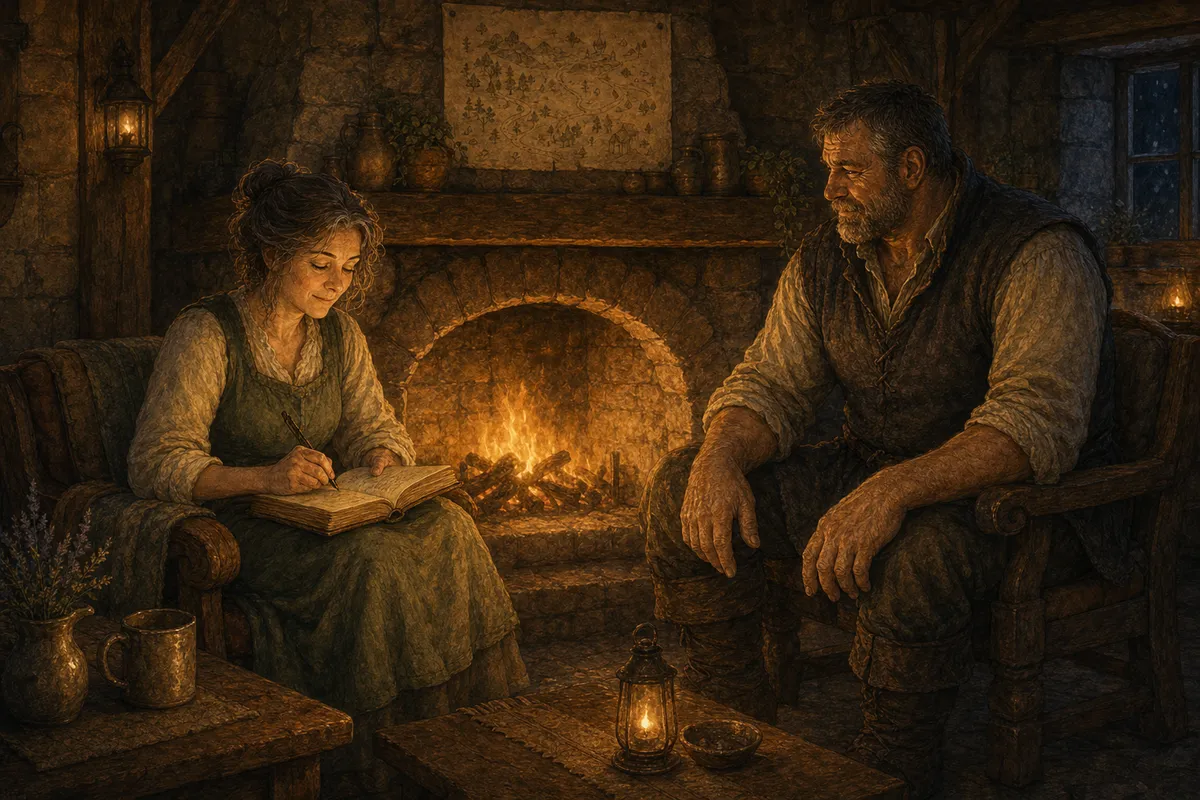
Safe. And warm. And told.