The first guest of the autumn arrived with the rain, and arrived talking.
He came in soaked to the knees, a leather case clutched to his chest like a child holds a loaf, and before the door had even shut behind him he was apologizing — to the door, to the puddle he was making, to Marrow Wren, to the fire itself for dripping near it. He was young, all elbows and enthusiasm, with ink permanently grey in the creases of his fingers.
“Pip,” he said, when Marrow set the soup in front of him without being asked. “Pip Lark. I'm a mapmaker. Well — I'm becoming a mapmaker. There's a difference, my master says, and the difference is about four hundred miles of walking, so.” He grinned. “I've nearly closed the gap.”
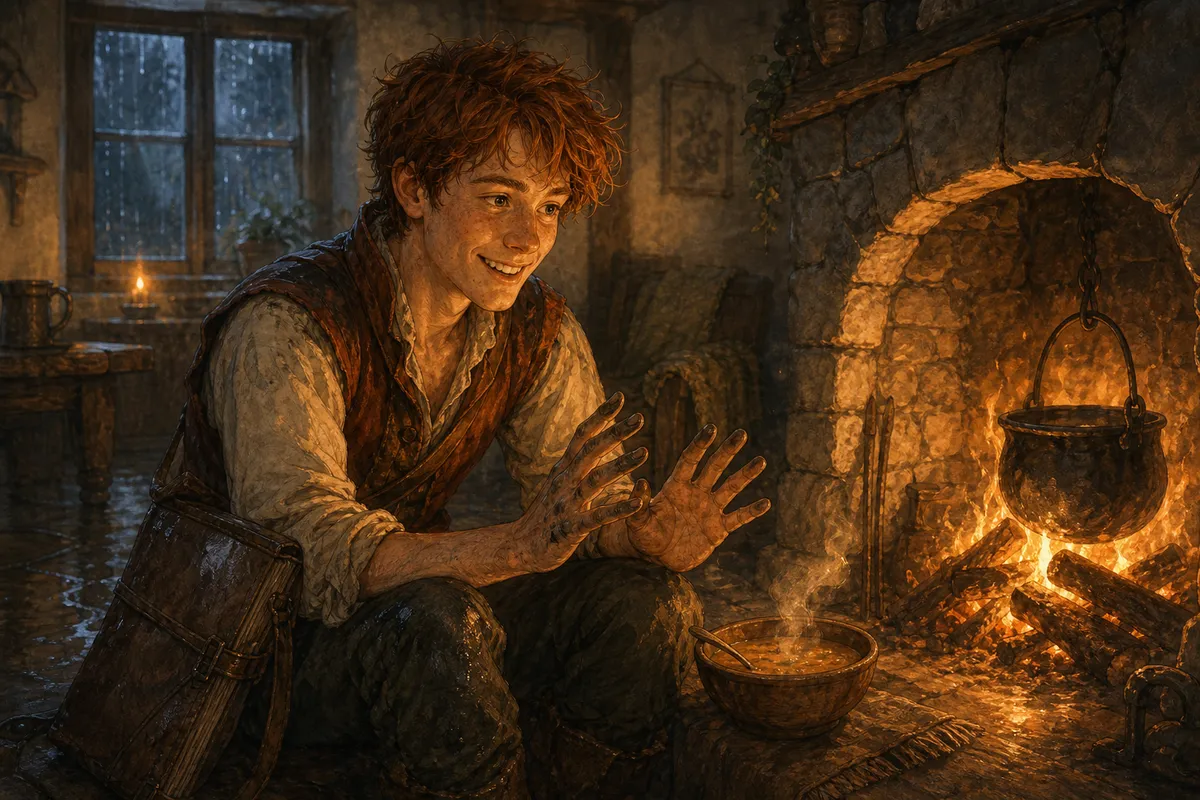
Marrow let him warm. She had learned that some stories need to be coaxed out and some, like Pip's, only need a door held open. She held it open with the smallest of questions.
“Where did you start?”
“Sunrise Harbor.” His whole face changed when he said it — the way a person's face changes at the name of a place they love. “East coast. You know it? The whole town faces the water, so the first light hits it before anywhere else in the Lands. They say if you're going to begin something, begin it there. I had two clean sheets of paper and a head full of my master's warnings and I thought — yes. Here. This is where I find out if I can do the thing I want to do.”
“And what is the thing you want to do?”
Pip set down his spoon. This, clearly, was the question he had been walking four hundred miles to be asked.
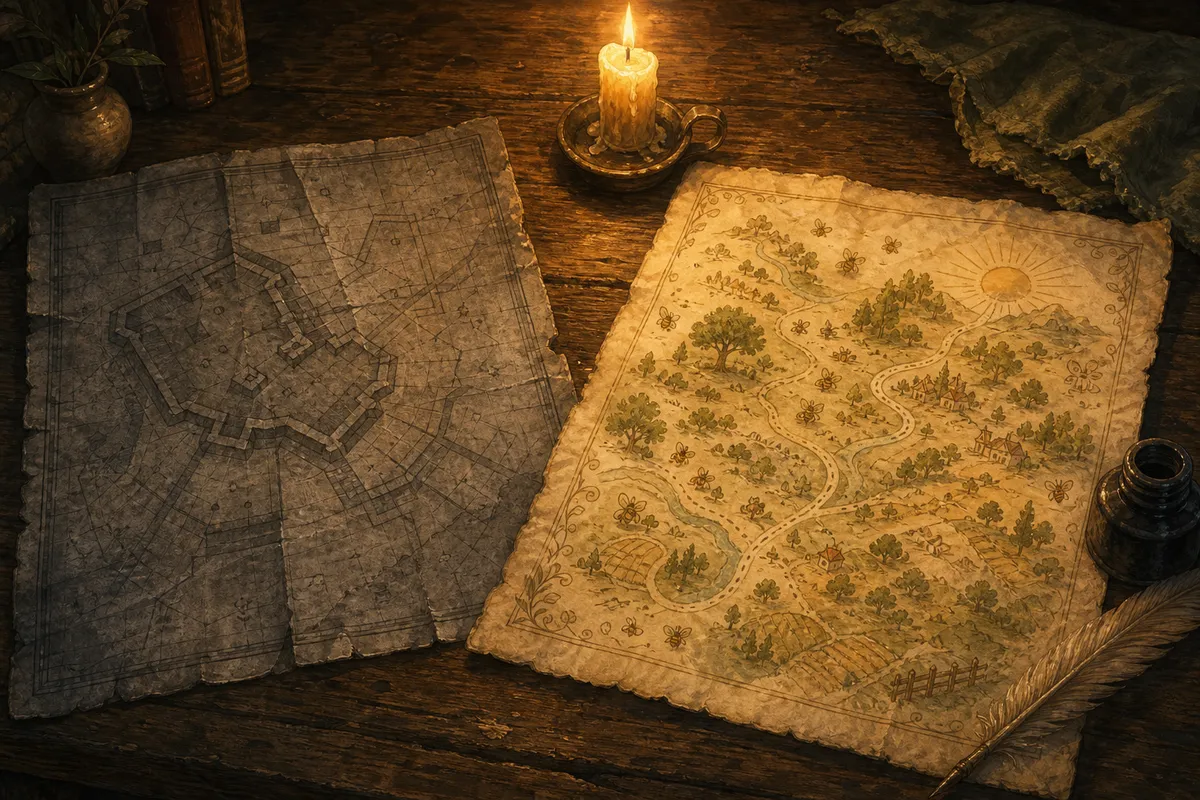
“I want to map the world,” he said. “Not for armies. Not for kings deciding where to push a border. Those maps already exist — my master has a whole chest of them, all old, all from the loud years, and they're ugly. They only show what a place is good for. Where the choke points are. Where you'd put a wall.” He shook his head. “But the wars are over. Nobody needs those maps anymore. So I thought — what if I made the other kind? A map of where the world is beautiful. Where the light is good in the morning. Where an old woman keeps bees you're allowed to taste. Where the road bends and suddenly the whole valley opens up and you have to stop walking for a minute, just to look.”
Marrow Wren, who had walked a great many roads before she chose to stop at this one, said nothing. But she refilled his bowl.
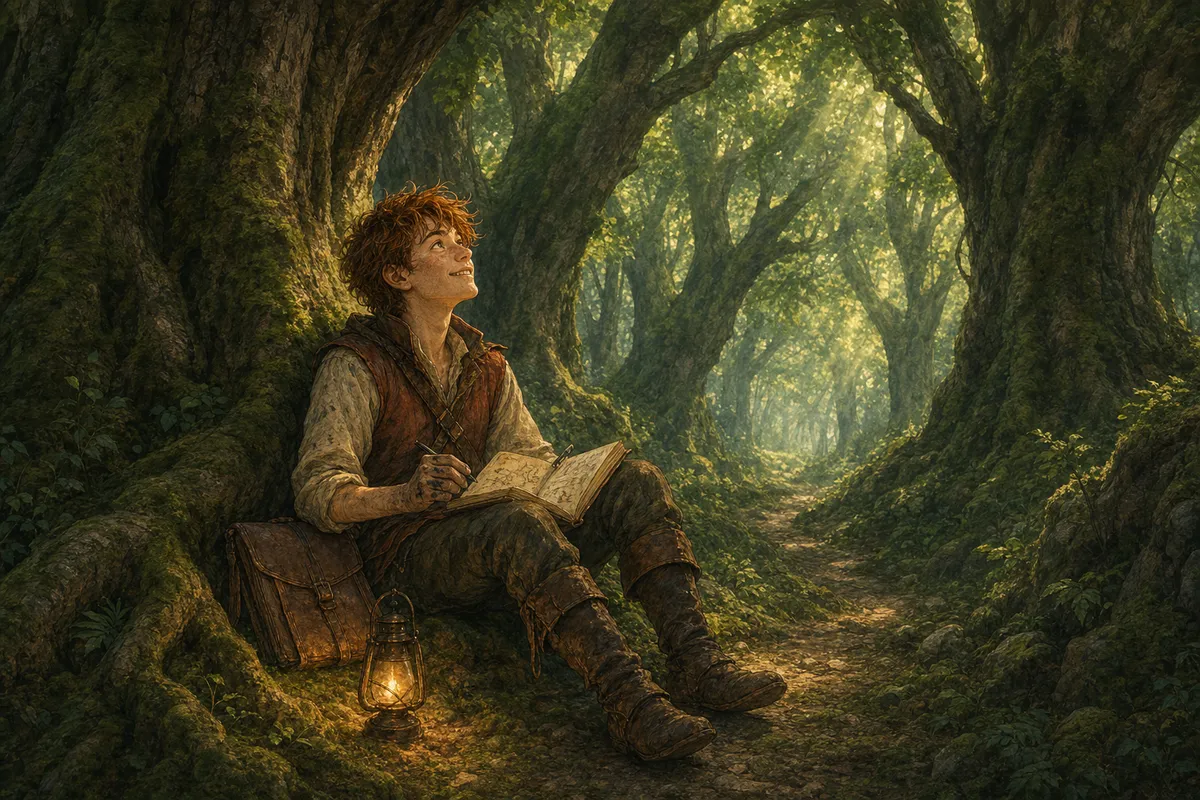
“So I walked,” Pip went on. “Out of the harbor and inland, onto the old forest road — the long one, the one everyone tells you to skip because the new road's faster.” He laughed quietly. “But the fast road doesn't have the whispers.”
“The whispers.”
“That's what the carters call it. Whispers along the ancient forest path.” He said it carefully, the way you handle something fragile. “It's the oldest road in the Lands. Older than the wars, older than the kingdoms. The trees lean right over it so it's always half-dark and green, and when the wind moves up high you'd swear the whole forest is murmuring to itself. Telling the long story it's been telling since before anyone was here to listen.” He looked into the fire. “I was scared of it, the first night. Sleeping out there alone with all that talking overhead. But by the third night I understood it wasn't talking at me. It was just — going on. The way a river goes on. And there's something kind about that, isn't there? That the world was here long before you, and it's not waiting on you, and it'll keep murmuring its story long after. It made me feel small in the good way. The restful way.”
He had stopped performing now. The grin had softened into something truer.
“That's when I knew my map was real,” he said. “Not when I drew the harbor. When I sat under those old trees and drew the feeling of them. A map of a place no one needs to conquer. Just a place that's allowed, finally, to be beautiful.”
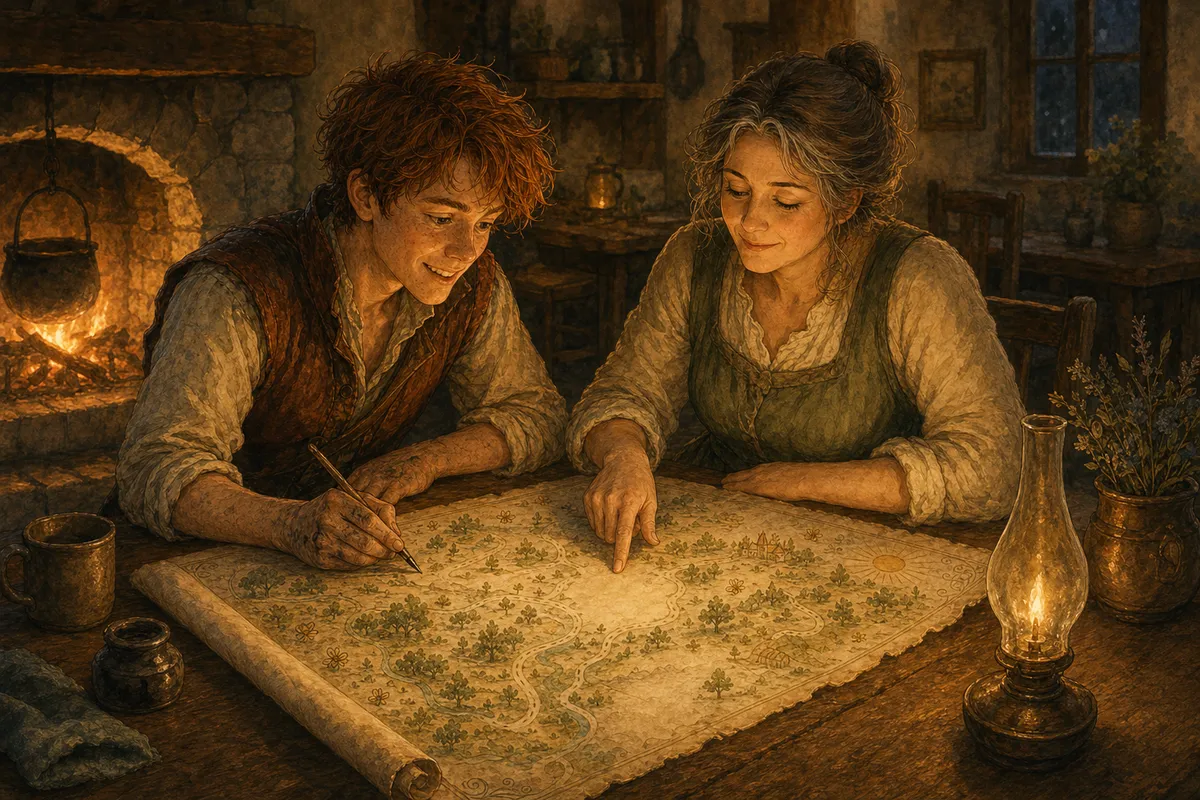
After a while he opened the leather case — carefully, the way you'd open a window onto a sleeping room — and unrolled the map across the long table for her to see.
It was unfinished, of course. Half the Lands were still only blank cream paper, waiting. But where he had been, the page was alive. The harbor was a scatter of little boats and a sun drawn low and generous over the water. The forest road wound through in soft green, and along its edge, in a hand so small Marrow had to lean close, he had written the things you could not survey: here the birds go quiet at noon. here the moss is soft enough to sleep on. here, if you are tired, the road forgives you.
“My master will say it's not a real map,” Pip admitted, suddenly shy now that someone was actually looking. “No scale. No proper borders. He'll say you can't use it for anything.”
Marrow Wren studied it a long moment. Then she set a fingertip, very gently, on the blank space just past the forest road — the empty cream where the three roads would one day meet, where the valley was, where they were sitting now.
“You'll want to mark this,” she said. “When you draw it. A good place to stop.”
Pip looked at the spot under her finger, and then at the fire, and then at the rain-blurred window where his whole unmapped road still waited in the dark. Something in his face went quiet and certain, the way a person looks when they've just been handed a reason they didn't know they were missing.
“I will,” he said. “I'll draw it warm.”
Outside, the rain settled into the steady, companionable kind that no longer means to go anywhere. Pip Lark finished his second bowl and, somewhere in the warmth and the fire and the murmur of it all, ran finally out of words — which, for Pip, was its own kind of arrival.
Marrow Wren took down her book. She did not write what he was good for, or where the choke points were, or where you'd put a wall. She wrote, in her small even hand, that on the first rainy night of autumn a young mapmaker had stopped here, on his way to draw a kinder map of the world, and that he had reminded her — as guests sometimes do, without ever meaning to — why she had chosen to stop walking, at exactly this crossroads, where all the roads come in.
Then she made up a bed with a blanket of good wool, and let the fire burn low, and the inn kept his story the way it keeps them all.
Safe. And warm. And told.